Your lips need sun protection just as much as the rest of your face. Regular exposure to ultraviolet (UV) rays can contribute to lip damage, dryness and changes in lip appearance. Over time, inadequate sun protection may also contribute to uneven pigmentation.
If you spend time outdoors, commute regularly or live in a sunny climate, protecting your lips should be part of your daily skincare routine.
The good news is that a few simple habits can help reduce unnecessary sun exposure and support healthier-looking lips. In this guide, we explain how sun exposure affects your lips and the practical steps you can take to help prevent sun-related lip pigmentation.
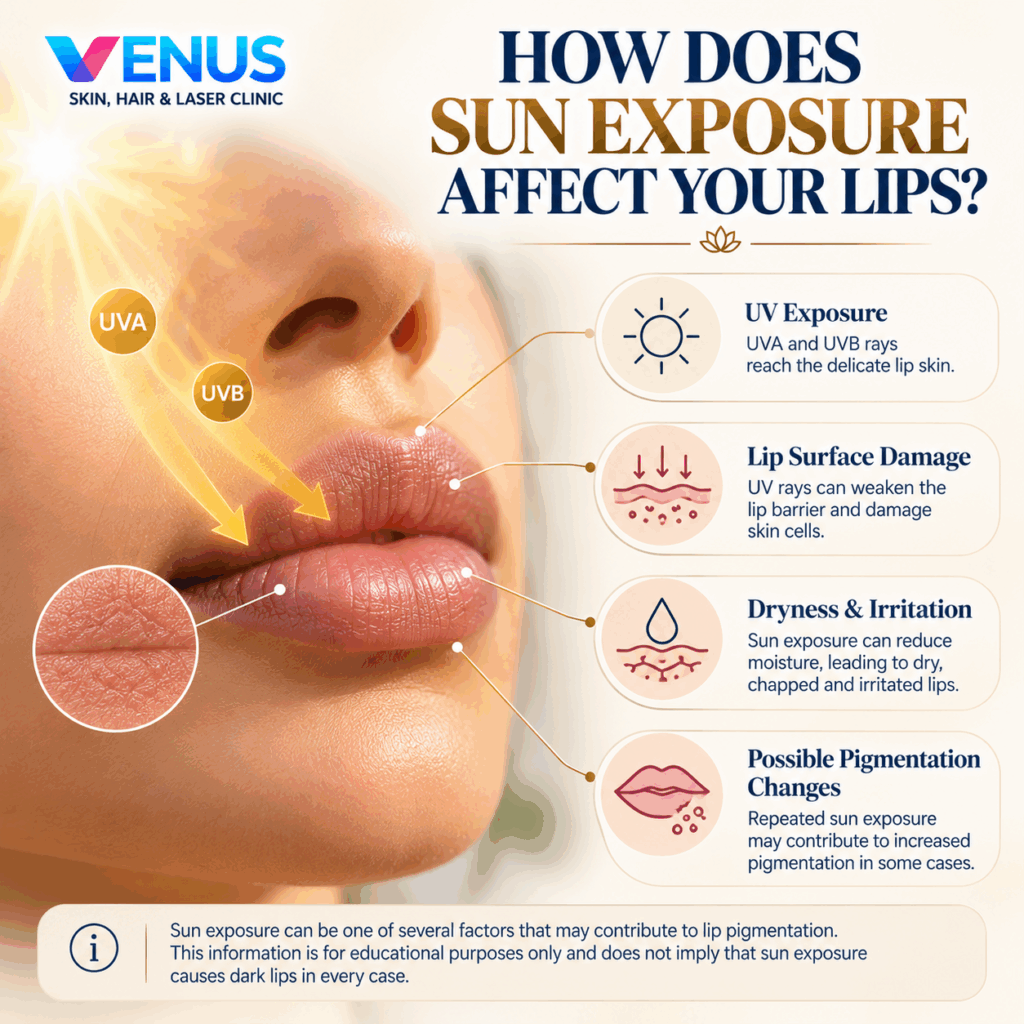
Yes. Sun exposure can contribute to changes in lip colour in some individuals.
The lips have a different structure from the surrounding facial skin. The outer lip surface has a relatively thin protective barrier and is more vulnerable to environmental damage.
Repeated exposure to ultraviolet radiation may contribute to:
Increased pigmentation or uneven lip colour.
Dryness and chapping.
Sun-related inflammation and irritation.
Long-term sun damage to the lip surface.
The lower lip is particularly vulnerable to chronic sun exposure. Prolonged UV damage can also cause a condition called actinic cheilitis, which may present as persistent dryness, roughness, scaling or other changes to the lip surface.
It is important to understand that not all naturally dark lips are caused by sun exposure. Genetics, irritation, smoking and other factors can also influence lip colour.
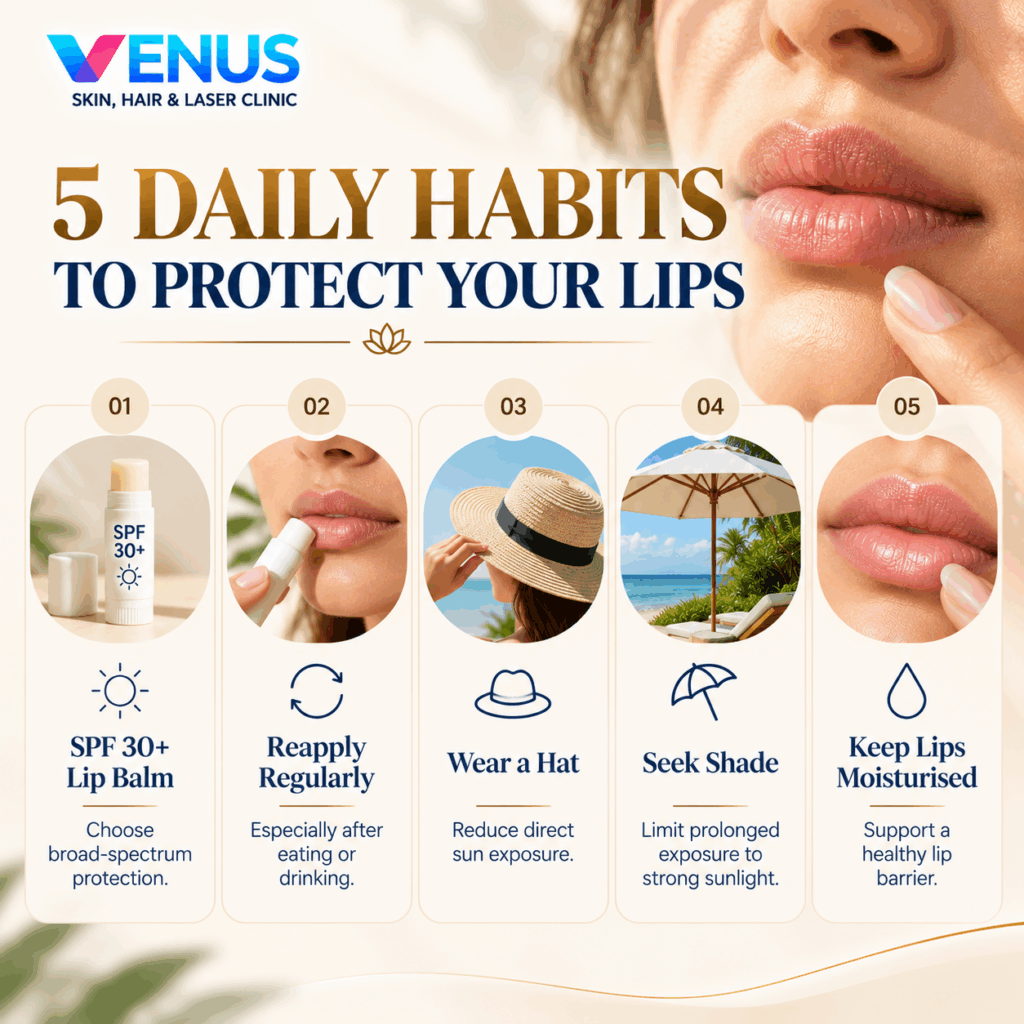
Preventing unnecessary UV exposure is an important part of maintaining lip health. Here are seven practical steps to include in your daily routine.
One of the simplest ways to protect your lips is to use a lip balm that contains sunscreen.
Choose a lip product with:
SPF 30 or higher.
Broad-spectrum UVA and UVB protection, where available.
A formulation suitable for regular use on your lips.
Moisturising ingredients that help maintain the lip barrier.
Apply it before going outdoors, even if you are only stepping out for a short commute or walk.
Remember that ordinary moisturising lip balm without SPF does not provide the same UV protection as a sunscreen-containing product.
Applying SPF lip balm once in the morning may not provide protection throughout the day.
Lip products can wear off when you eat, drink, wipe your mouth or talk. This is why regular reapplication matters.
A practical routine is to:
Apply SPF lip balm before heading outdoors.
Reapply approximately every two hours while outdoors.
Reapply after eating, drinking or wiping your lips.
Follow the product’s instructions, particularly if it is water-resistant.
Consistent application is more useful than applying a large amount only occasionally.
Sunscreen is important, but physical protection can also help reduce direct sun exposure.
A wide-brimmed hat can provide additional shade for your face and lips, particularly when you spend extended periods outdoors.
Consider wearing one when:
Walking or travelling during sunny hours.
Spending time outdoors for work.
Visiting beaches or open areas.
Participating in outdoor activities.
A hat should complement SPF lip protection rather than replace it.
Try to reduce prolonged exposure to strong sunlight whenever practical.
You can make small changes to your routine:
Prefer shaded walking routes.
Use an umbrella when outdoors.
Take breaks in shaded areas.
Plan outdoor activities to reduce unnecessary exposure during periods of intense sunlight.
Remember that UV exposure can still occur on cloudy days. Lip protection should therefore be part of your regular outdoor routine, not something reserved only for summer or holidays.
Sun exposure, heat and environmental conditions can leave your lips feeling dry and uncomfortable.
Dry, irritated lips may become more vulnerable to repeated inflammation, especially when combined with habits such as licking, biting or peeling the skin.
To maintain a healthy lip barrier:
Use a gentle, fragrance-free moisturising lip balm.
Apply it regularly throughout the day.
Use a suitable moisturiser before bedtime.
Avoid picking or peeling dry skin from your lips.
Moisturising does not replace sun protection, but it helps maintain lip comfort and reduce dryness.
Some lipsticks, lip balms, fragrances, flavouring agents and cosmetic products may cause irritation or allergic reactions in susceptible individuals.
Repeated inflammation can sometimes contribute to pigmentation changes.
Pay attention to symptoms such as:
Burning or stinging after applying a product.
Itching or redness.
Swelling or peeling.
Persistent dryness or irritation.
If a particular product repeatedly causes discomfort, stop using it. Choose gentle products with minimal fragrance and avoid products that trigger irritation.
If symptoms continue, consult a dermatologist to identify the possible cause.
Licking your lips may temporarily make them feel moist, but saliva evaporates quickly and can leave them drier.
Repeated licking, biting and picking can also irritate the lip surface.
Make a habit of:
Using a gentle moisturising lip balm when your lips feel dry.
Avoiding repeated lip licking.
Not peeling or biting loose skin.
Allowing irritated lips time to recover.
Reducing repeated irritation can help support a healthier lip barrier.
Not every lip balm offers protection against UV radiation.
When choosing a lip balm for everyday sun protection, look for the following features:
| Feature | What to look for |
|---|---|
| SPF | SPF 30 or higher |
| UV protection | Broad-spectrum UVA and UVB protection |
| Moisturisation | Ingredients that help maintain the lip barrier |
| Formulation | Comfortable for regular lip application |
| Sensitivity | Fragrance-free or low-irritant options if your lips are sensitive |
Some people with sensitive lips may prefer mineral sunscreen ingredients such as zinc oxide or titanium dioxide. However, individual tolerance can vary.
If a product causes burning, itching or irritation, discontinue it and consider seeking dermatological advice.
No. Sunscreen is an important preventive measure, but it cannot prevent every cause of lip pigmentation.
Lip colour can be influenced by several factors, including:
Genetics and natural skin pigmentation.
Repeated sun exposure.
Smoking and tobacco use.
Irritation or allergic reactions to lip products.
Repeated inflammation.
Certain medications and underlying conditions.
SPF lip balm can help protect against UV-related damage, but it does not guarantee that pigmentation will never develop.
If your lip colour is changing despite consistent sun protection, the underlying cause may need to be evaluated.
Existing lip pigmentation may require a different approach from prevention.
The appropriate treatment depends on the cause, extent of pigmentation, lip condition and individual suitability.
A dermatologist may first assess whether the colour change is related to sun exposure, natural pigmentation, irritation or another condition.
Depending on the diagnosis, treatment planning may involve:
Identifying and avoiding possible irritants.
Improving daily lip care and sun protection.
Addressing any underlying inflammation.
Considering suitable dermatologist-guided procedures where appropriate.
Not every type of lip pigmentation requires a procedure. Treatment should be selected only after understanding the cause.
If you are concerned about uneven or persistent lip pigmentation, consider consulting a dermatologist for an individual assessment.
Explore lip pigmentation treatment in Chennai at Venus Skin Clinic to understand the available assessment and treatment options.
Occasional dryness or temporary changes in lip appearance may not be a cause for concern. However, persistent or unusual changes should not be ignored.
Consider seeking medical advice if you notice:
Persistent darkening or uneven pigmentation.
A rough or scaly patch that does not heal.
Repeated cracking, bleeding or soreness.
A persistent ulcer or unusual spot.
Changes in lip texture or the border between the lips and surrounding skin.
Long-term sun damage can sometimes cause actinic cheilitis, which requires medical evaluation. Do not assume that every persistent dark or rough patch is ordinary pigmentation.
 Is Pico Laser Safe for Indian Skin Tones? How to Prevent Post-Laser Pigmentation
 Benefits of Cosmelan Peel for Pigmentation
 Pico Laser for Pigmentation in Chennai
 Pigmentation Treatment in Chennai: Why Creams Alone Don’t Work
 Chemical Peel for Pigmentation: Say Goodbye to Skin Imperfections!
 Does Laser Hair Removal Cause Pigmentation? Dermatologist Explains
 Pigmentation Treatment Chennai for Clearer, Even-Toned Skin
 Pico Laser vs Chemical Peels for Pigmentation: Which Is Best for Your Skin?
 Effective Chemical Peel for Pigmentation – Venus Skin Clinic
 Understanding Pigmentation Disorders: Causes, Implications & Modern Treatment Approaches
 How Many Pico Laser Sessions Are Needed for Pigmentation? Cost & Treatment Timeline in Chennai
 Melasma vs. Post-Acne Dark Spots: Which Pigmentation Type Can Pico Laser Treat?
