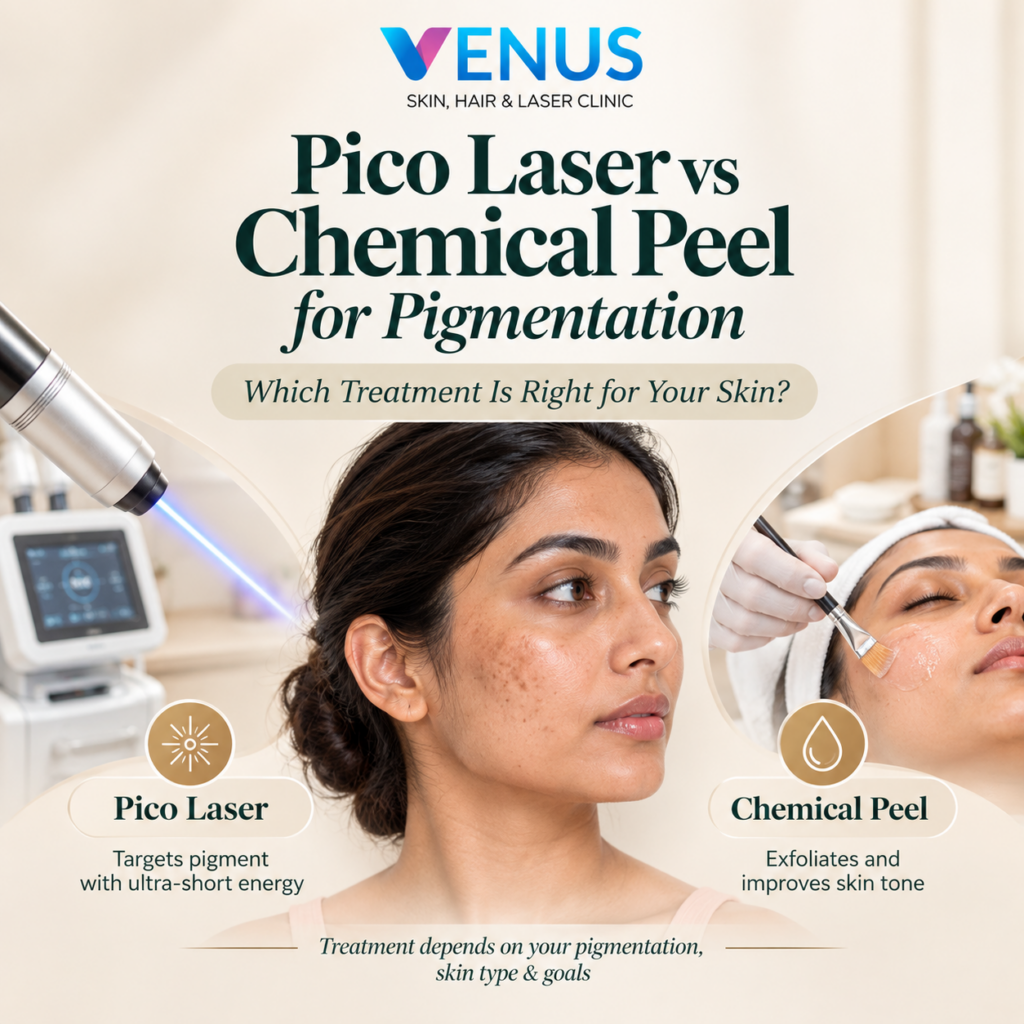
Choosing a pigmentation treatment can be confusing when both Pico Laser and Chemical Peels are commonly discussed for dark spots, uneven skin tone and post-acne pigmentation. The right option depends less on which treatment sounds more advanced and more on what type of pigmentation you have, how deep or persistent it is, your skin tone, your tolerance for downtime and your treatment goals.
As a general guide, Chemical Peels may be useful when controlled exfoliation is appropriate for superficial pigmentation, acne-related marks and uneven texture. Pico Laser may be considered when more targeted treatment of persistent pigment is appropriate, particularly when a dermatologist determines that laser therapy is suitable for your skin and pigmentation pattern.
If you are considering laser treatment, Learn more about our customized Pico Laser treatment options at Venus Skin Clinic to understand how treatment can be planned according to your pigmentation and skin type.
The important point is that neither treatment is automatically the “best pigmentation treatment for dark spots” for every patient. Diagnosis comes first.
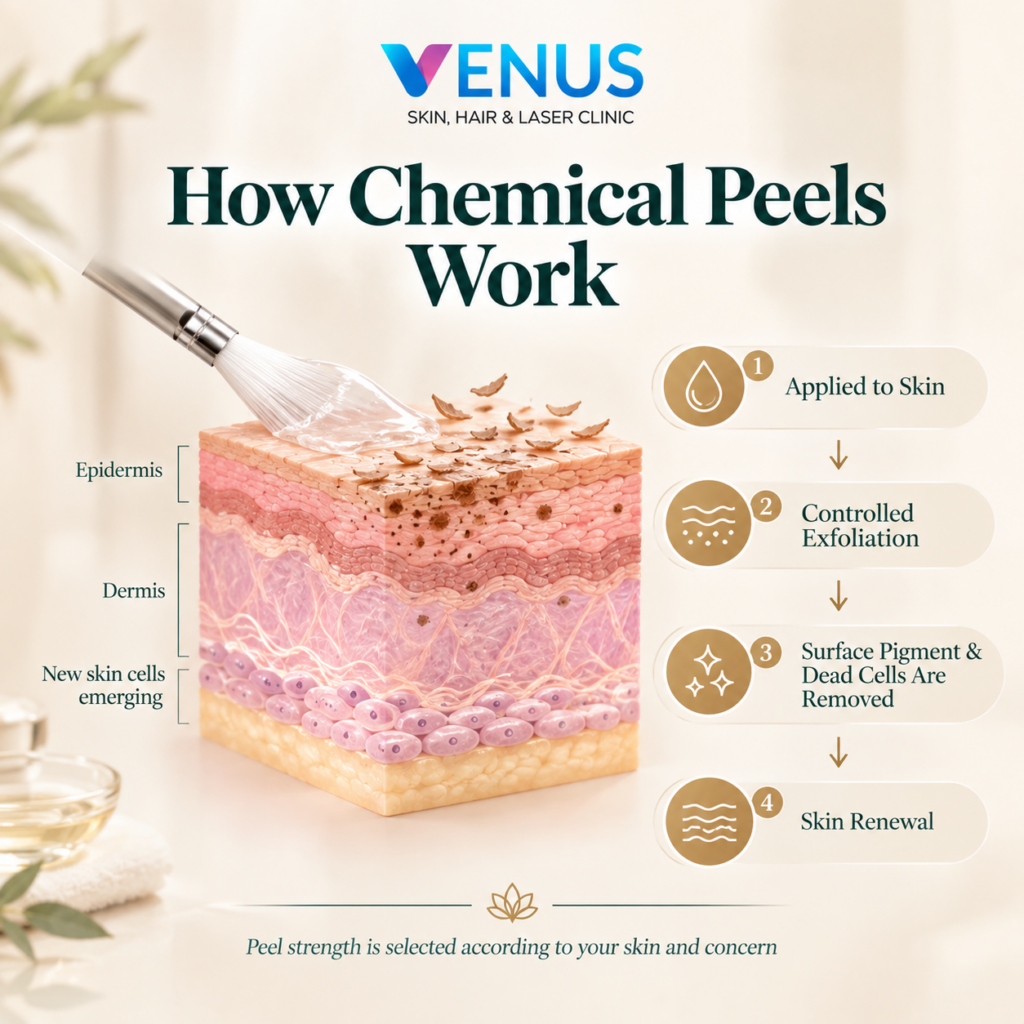
Chemical peels use carefully selected chemical solutions to create controlled exfoliation of the skin. Depending on the formulation and strength, ingredients such as alpha hydroxy acids (AHAs), beta hydroxy acids (BHAs) and trichloroacetic acid (TCA) can be used for different skin concerns.
The treatment encourages removal of superficial damaged skin cells and supports skin renewal. Some peels can also improve the appearance of uneven pigmentation and acne-related marks while helping with texture and congestion.
A dermatologist may consider a chemical peel for concerns such as:
The specific peel matters. A superficial glycolic or salicylic acid peel is very different from a stronger TCA peel, so “chemical peel” should not be treated as one single treatment.
Controlled exfoliation:
Peels can help remove superficial layers of pigmented or damaged skin.
Can address multiple concerns:
Depending on the formulation, a peel may help with pigmentation, acne, oiliness and texture at the same time.
Generally lower per-session investment:
Chemical peels can have a lower cost per session than many laser procedures, although the total treatment cost depends on the number and type of sessions required.
Flexible treatment options:
The concentration and type of peel can be selected according to the patient’s skin condition.
Chemical peels are not suitable for every pigmentation problem. A superficial peel may have limited benefit when pigment is persistent, recurrent or located deeper within the skin.
Peels can also cause irritation or pigmentary complications when the wrong strength is used or when aftercare and sun protection are inadequate.
For Indian and other darker skin types, conservative treatment selection is particularly important because inflammation itself can trigger post-inflammatory hyperpigmentation.
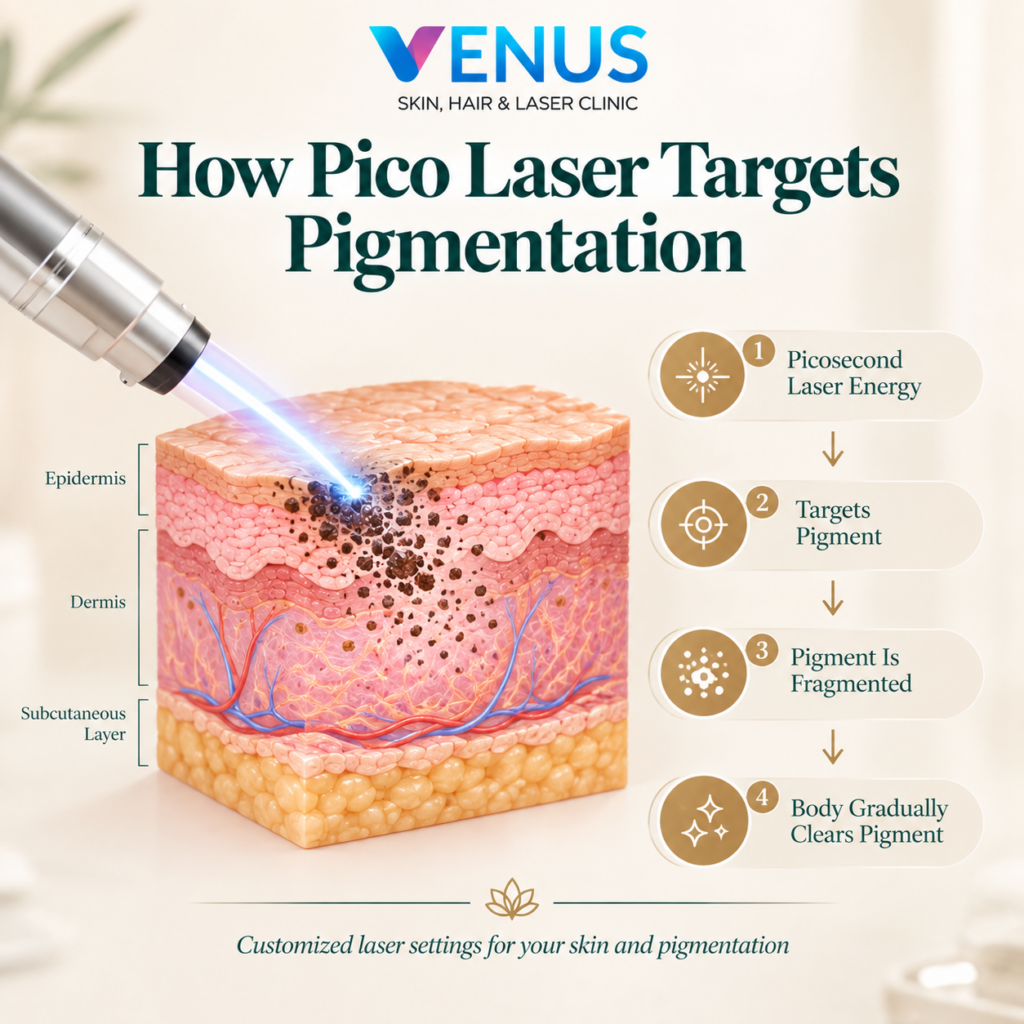
Pico Laser uses extremely short laser pulses measured in picoseconds. Rather than relying primarily on prolonged heating, picosecond technology can produce a strong photoacoustic effect, helping fragment targeted pigment into smaller particles that the body can gradually clear.
This makes Pico Laser a targeted option for selected pigmentation concerns.
However, the phrase “deeper pigmentation” should not automatically mean “Pico Laser is better.” Pigmentation can have different causes and depths, and laser treatment must be selected according to the diagnosis, skin type and clinical pattern.
Depending on the diagnosis and laser system used, Pico Laser may be considered for:
Melasma requires particular caution.
It is a chronic, recurrent pigmentary disorder rather than simply a collection of dark spots. Although laser and light-based procedures can have a role in selected cases, they are not universally appropriate and recurrence remains an important consideration.
For this reason, a dermatologist may use Pico Laser only as part of a broader management strategy involving appropriate skincare, pigment-control treatment and strict photoprotection.
Targeted energy:
Laser energy can be directed toward specific pigment concerns rather than relying solely on surface exfoliation.
Short pulse duration:
Picosecond technology is designed to deliver energy over an extremely short period, producing a predominantly photoacoustic effect.
Useful for selected persistent pigmentation:
When appropriate for the diagnosis, it can be considered when superficial approaches alone have not provided sufficient improvement.
Pico Laser is usually a higher per-session investment than a basic chemical peel.
It also requires careful parameter selection, especially in darker skin. Incorrect wavelength, fluence, spot size, treatment density or excessive energy can increase the risk of unwanted pigmentary changes.
More advanced technology does not remove the need for diagnosis and conservative treatment planning.
| Feature | Chemical Peel | Pico Laser |
|---|---|---|
| Primary mechanism | Controlled chemical exfoliation | Short-pulse laser energy with a predominantly photoacoustic effect |
| Pigmentation focus | Often useful for superficial pigmentation and selected acne marks | Can be considered for selected persistent or treatment-resistant pigment |
| Treatment depth | Depends on peel type and strength; superficial peels mainly affect superficial skin layers | Depends on wavelength, device and settings; treatment can be targeted according to the clinical indication |
| Typical downtime | Varies from minimal redness to several days of peeling depending on peel | Often limited, but redness or other temporary reactions can occur depending on settings |
| Sessions required | Usually a series rather than one treatment | Usually a series rather than one treatment |
| Best suited to | Selected superficial pigmentation, acne-related marks, texture and dullness | Selected persistent pigmentation and dark spots when laser is clinically appropriate |
| Cost per session | Generally lower for superficial peels | Generally higher |
| Main safety consideration | Irritation and post-inflammatory pigmentation if improperly selected | Pigmentary changes if incorrect parameters are used |
| Indian skin consideration | Peel strength must be carefully selected | Laser wavelength and settings must be carefully selected |
| Best approach | Personalized according to skin condition | Personalized according to diagnosis, skin type and pigment pattern |
There is no reliable universal number of sessions that applies to every patient.
A treatment plan depends on:
So, claims such as “4–8 peels” or “3–6 Pico sessions” should be treated as general examples rather than promises of a specific result.
One of the most common questions patients ask is about Pico Laser cost vs chemical peel.
In general, a Pico Laser session requires a higher per-session investment than a superficial chemical peel because it involves specialized laser equipment, treatment parameters and device-based delivery.
However, comparing only the price of one session can be misleading.
The total treatment cost may depend on:
A lower-cost procedure is not necessarily the more appropriate treatment if it is poorly matched to the pigmentation.
The more useful question is:
Which treatment is appropriate for your pigmentation, skin type and long-term goal?
Sometimes, yes—but combination treatment should not mean performing multiple procedures simply because they are available.
For complex pigmentation, a dermatologist may consider a combination approach where different treatments address different aspects of the condition.
For example, a patient may have:
In such situations, a dermatologist may decide that one modality alone is not the most appropriate strategy.
However, combining treatments also increases the need for careful timing and skin recovery. Performing aggressive procedures too close together can increase inflammation, which may worsen pigmentation in susceptible skin.
For Indian skin, the goal should be controlled treatment with the lowest unnecessary inflammatory burden, rather than using the maximum possible treatment intensity.
Indian skin commonly falls within the Fitzpatrick III–V range, although individual skin tones can vary widely. Patients with darker skin have a greater risk of post-inflammatory hyperpigmentation after skin injury or inflammation.
That does not mean lasers or chemical peels are unsuitable.
It means treatment needs to be selected and performed carefully.
1. What type of pigmentation is present?
Melasma, PIH, tanning, lentigines and other pigmentary disorders do not necessarily require the same treatment.
2. Where is the pigment located?
The clinical pattern and suspected depth can influence treatment selection.
3. Is the pigmentation still being triggered?
Active acne, irritation, sun exposure and other inflammatory triggers may need to be controlled.
4. How sensitive is your skin?
A history of irritation or pigmentation after previous treatments is important.
5. What treatments have already been tried?
Previous peels, lasers and skincare products can affect the treatment plan.
For darker skin, aggressive treatment can sometimes create another pigmentation problem.
The aim is to improve pigmentation while minimizing unnecessary inflammation and protecting the skin barrier.
At Venus Skin Clinic, the approach is diagnosis first, treatment second. A dermatologist-led assessment helps determine whether Pico Laser, a chemical peel, another treatment option or a combination approach is appropriate for the individual patient.
There is no single answer because “dark spots” can describe several different conditions.
This is why searching only for the best pigmentation treatment for dark spots can be misleading. The best option depends on the actual cause of the pigmentation.
Melasma deserves separate consideration.
It is commonly recurrent and can be influenced by factors including UV exposure, hormonal influences, inflammation and visible light. Treatment therefore usually requires more than simply removing existing pigment.
Chemical peels may be used in selected patients, particularly as part of a broader pigmentation-management plan.
Laser procedures, including picosecond technology, may also be considered in selected cases, but evidence for laser treatment of melasma is variable and recurrence remains a concern.
Therefore, Pico Laser should not be presented as a guaranteed or universally superior treatment for melasma.
A dermatologist may instead build a longer-term plan that combines:
For melasma, controlling recurrence is just as important as improving visible pigmentation.
Downtime varies considerably depending on the treatment intensity.
A superficial peel may cause:
The amount of visible peeling depends on the specific peel and its strength. Deeper peels can involve substantially more downtime and are not equivalent to superficial cosmetic peels.
Depending on the device and treatment parameters, patients may experience:
Some patients have little visible downtime, while others may experience a more noticeable reaction.
Therefore, it is better to ask your dermatologist:
“What downtime should I expect with the specific treatment and settings being recommended for my skin?”
rather than relying on a fixed 24- or 48-hour rule.
Use these questions as a starting point before booking treatment.
Ask:
Is my pigmentation superficial or persistent?
Is it caused by acne, sun exposure, melasma or another condition?
Do I also have active acne or uneven texture?
Have I developed pigmentation after previous treatments?
How much downtime can I realistically manage?
What is the total treatment cost rather than just the price per session?
Does the clinic have a dermatologist assessing my pigmentation before treatment?
These questions can help you have a more useful consultation and avoid choosing a procedure simply because it is currently popular.
Pigmentation treatment requires more than selecting a machine or peel.
At Venus Skin Clinic, Nungambakkam, treatment planning is based on the patient’s pigmentation pattern, skin condition and treatment goals.
The focus is on:
The goal is not to promise instant or permanent pigment removal. It is to develop a treatment plan that improves pigmentation while respecting the behavior and sensitivity of the patient’s skin.
If you are deciding between Pico Laser and Chemical Peels for pigmentation, there is no universal winner.
A Chemical Peel may be appropriate for selected superficial pigmentation, acne-related marks, uneven tone and texture, particularly when controlled exfoliation is suitable.
Pico Laser may be considered for selected persistent pigmentation and dark spots when targeted laser treatment is appropriate for the patient’s diagnosis and skin type.
For melasma and pigmentation-prone Indian skin, treatment needs even more careful planning because inflammation can contribute to further pigmentation.
The most important decision is therefore not simply Pico Laser vs Chemical Peel.
It is:
“Which treatment is appropriate for my specific pigmentation and skin?”
At Venus Skin Clinic in Nungambakkam, Chennai, pigmentation treatment is planned following a dermatologist-led assessment.
Consult Dr. Sharanya Karthik at Venus Skin Clinic to discuss whether Pico Laser, a Chemical Peel or another approach may be suitable for your skin.
Venus Skin Clinic
4, Nageshwara Road, Nungambakkam, Chennai
Near Child Trust Hospital
Call: +91 777 000 2118
 Is Pico Laser Safe for Indian Skin Tones? How to Prevent Post-Laser Pigmentation
 Chemical Peels vs. Laser Treatment: Which Is Better for Acne Scars?
 Pico Laser for Pigmentation in Chennai
 How Many Pico Laser Sessions Are Needed for Pigmentation? Cost & Treatment Timeline in Chennai
 Melasma vs. Post-Acne Dark Spots: Which Pigmentation Type Can Pico Laser Treat?
 Chemical Peels vs Facials: What Actually Improves Skin Texture?
 Venus Skin Clinic’s Ultimate Guide to Transformative Chemical Peels
 Customized Chemical Peels for Diverse Skin Types: The Personalized Approach at Venus Skin Clinic
 Chemical Peels for Acne: When Do They Work and When They Don’t?
 Benefits of Chemical Peels for Acne Scars
 Benefits of Chemical Peels for Acne Scars
 Chemical Peel for Pigmentation: Say Goodbye to Skin Imperfections!
