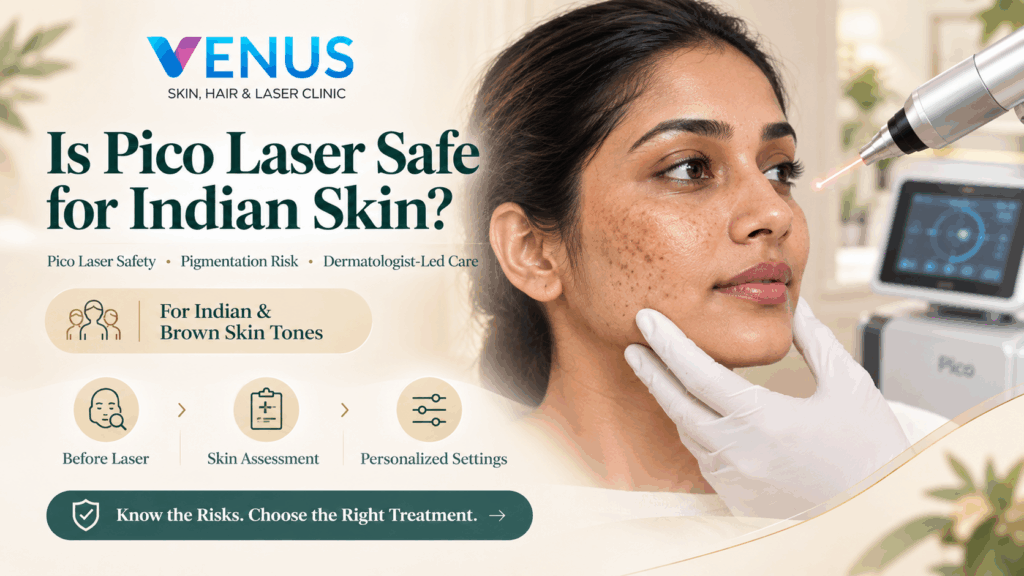
If you have brown or Indian skin, you may have heard concerns about laser treatments causing burns, darker patches or post-inflammatory hyperpigmentation (PIH). These concerns are worth taking seriously—but they do not mean Pico Laser is automatically unsafe for Indian skin.
Pico Laser can be used in selected Indian skin types when the treatment is appropriate, the laser parameters are carefully chosen and the patient’s skin is properly assessed beforehand. The risk is not simply about using a laser; it is about using the right technology, wavelength, energy, treatment density and technique for the individual skin and condition.
If you’re considering Pico Laser for pigmentation, Read our full guide on dermatologist-led Pico Laser therapy in Nungambakkam to understand the treatment approach in more detail.
The most important question should therefore not be:
“Is Pico Laser safe for Indian skin?”
It should be:
“Is Pico Laser appropriate for my skin, my pigmentation and my specific treatment goal—and how will the treatment be performed safely?”
Skin with more melanin can be more susceptible to pigmentary changes after inflammation or injury.
When the skin becomes irritated, the healing response can sometimes stimulate additional melanin production. This can result in post-inflammatory hyperpigmentation, where an area becomes darker after a procedure, acne, irritation or injury.
This is one reason why patients with brown or darker skin should not choose a laser treatment based solely on the machine name.
Two patients can receive the same type of laser treatment but require different parameters depending on:
For Indian patients, careful treatment planning matters as much as the technology itself.
Like other energy-based procedures, Pico Laser is not completely risk-free.
Temporary reactions can include:
More significant complications can occur when energy-based treatments are used inappropriately.
The risk of post-inflammatory hyperpigmentation can increase when the skin experiences excessive inflammation or when treatment is poorly matched to the patient’s skin.
That is why “Pico Laser has minimal heat” should never be interpreted as “Pico Laser cannot cause burns or pigmentation.”
The technology may help reduce unnecessary thermal injury compared with some traditional laser approaches, but correct settings and technique remain essential.
Pico Laser delivers extremely short pulses of laser energy measured in picoseconds.
Depending on the device and treatment indication, these short pulses can produce a strong photoacoustic effect, helping target pigment while limiting unnecessary prolonged heat exposure.
For pigmentation, the objective is to target unwanted pigment while minimizing injury to surrounding tissue.
However, the actual treatment response depends on several variables.
Wavelength
Different wavelengths interact differently with pigment and tissue.
Fluence
The amount of energy delivered needs to be selected carefully.
Spot size
This can influence how energy is distributed within the treatment area.
Treatment density
Repeated or excessive passes can increase the inflammatory burden.
Pigmentation type
Melasma, PIH, sun-related pigmentation and other pigmentary conditions do not respond in exactly the same way.
Skin type
Darker skin may require a more conservative treatment strategy.
The safest treatment is not necessarily the strongest treatment.
Most short-term reactions are temporary, but patients should understand what can occur before undergoing treatment.
Mild redness immediately after treatment can occur as the skin responds to the laser.
Some patients may experience temporary swelling, particularly in sensitive areas.
The treated area may feel warm or sensitive for a short period.
Pigmented areas may sometimes appear darker before they gradually improve.
This is one of the main concerns for patients with darker skin.
PIH can occur when inflammation stimulates additional melanin production. Appropriate treatment selection, conservative parameters and post-treatment care are therefore important.
Inappropriate treatment can potentially result in areas becoming lighter than the surrounding skin.
Incorrect settings or inappropriate treatment can cause more significant skin injury.
This is why Pico Laser should not be treated like a routine facial. It is an energy-based medical procedure that requires appropriate patient selection and treatment planning.
There is no method that can guarantee zero risk of pigmentation.
However, several steps can help reduce unnecessary inflammation and pigmentary complications.
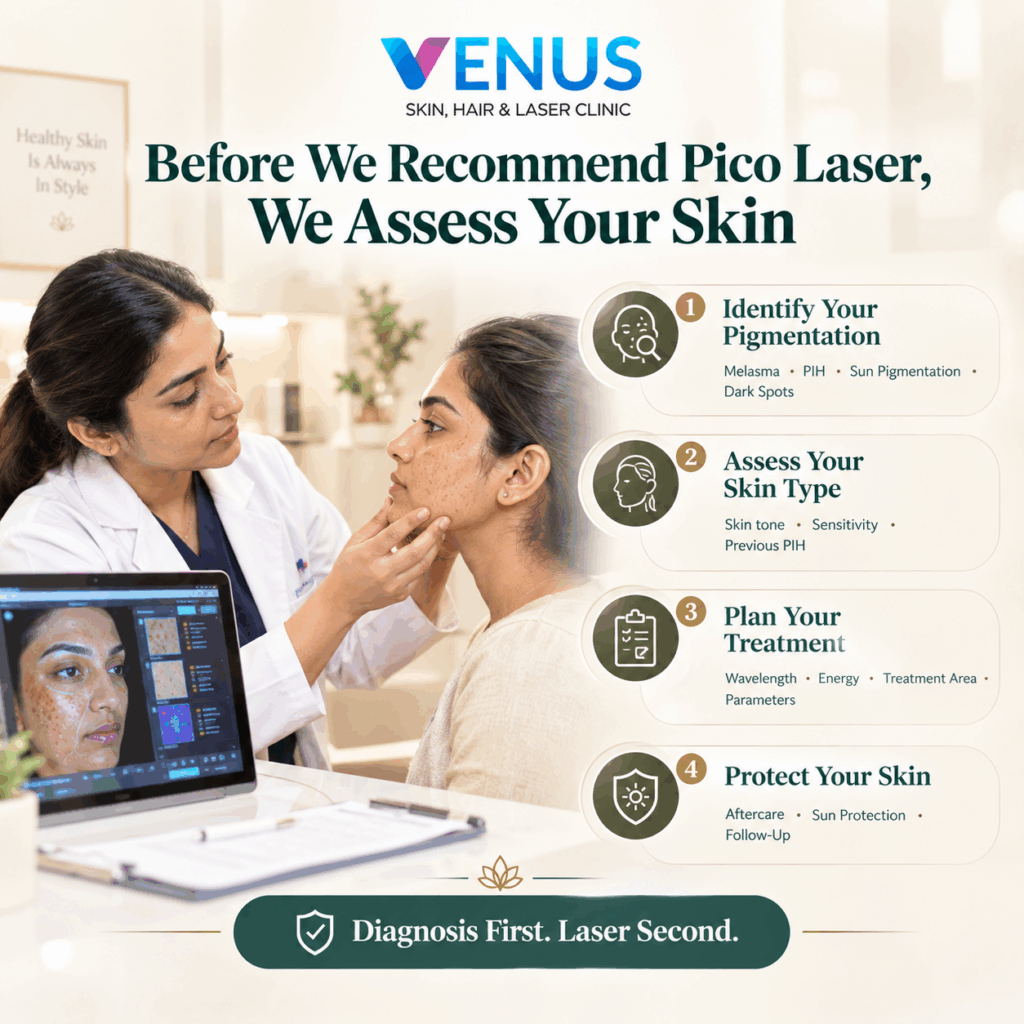
Not every brown patch is the same.
Before choosing Pico Laser, a dermatologist should determine whether the concern is:
Treatment should follow diagnosis—not the other way around.
Higher energy does not automatically mean better results.
For brown skin, the dermatologist needs to balance pigment targeting with the risk of unnecessary inflammation.
The appropriate settings depend on the:
A personalized protocol is preferable to applying the same settings to every patient.
If the skin barrier is already compromised, inflamed or excessively sensitive, additional procedures may increase irritation.
Your dermatologist may recommend stabilizing the skin before proceeding with laser treatment.
This can be particularly relevant for patients using strong exfoliating products, retinoids, acne medications or multiple active skincare ingredients.
Sun exposure can worsen pigmentation and may make it harder to maintain treatment results.
After treatment, appropriate photoprotection is particularly important.
Depending on your dermatologist’s advice, this may include:
For pigmentation-prone skin, sunscreen should not be considered an optional add-on to treatment.
Avoid introducing multiple new active ingredients immediately after treatment unless your dermatologist specifically recommends them.
Depending on the procedure, your post-treatment plan may include:
The correct aftercare depends on what was actually performed.
Pico Laser can be considered for selected patients with darker skin types, but Fitzpatrick classification alone does not determine whether treatment is appropriate.
Skin response also depends on:
For patients with darker skin, the goal should be effective pigment targeting with controlled inflammation.
A dermatologist may therefore use conservative parameters and assess the skin’s response before deciding whether treatment intensity should be changed.
A test spot or patch test may be considered in selected situations, particularly when there is uncertainty about how the patient’s skin will respond.
It is not a universal guarantee of safety.
A dermatologist may consider factors such as:
The decision should be individualized rather than following a one-size-fits-all rule.
Tell your dermatologist if you have:
This information helps the dermatologist decide whether treatment should proceed, be modified or be postponed.
Melasma requires particular caution.
Unlike an isolated dark spot, melasma is a chronic pigmentary condition that can recur. UV exposure, visible light, hormonal factors, heat and inflammation can contribute to its persistence.
Pico Laser may have a role in selected melasma patients, but it should not be presented as a guaranteed cure.
In some patients, the dermatologist may prioritize:
The objective is not simply to remove visible pigment temporarily.
It is to manage the condition while minimizing the risk of rebound pigmentation.
Before booking a treatment, ask these questions:
The treatment should be based on diagnosis.
You should understand the clinical reason for choosing laser treatment.
The exact answer depends on the device and indication, but the treatment should be individualized.
Patients with a history of PIH should specifically discuss this.
Your dermatologist can advise whether certain skincare products should be temporarily discontinued.
Clear aftercare instructions can help reduce unnecessary irritation.
A dermatologist should explain that session numbers depend on the pigmentation and treatment response rather than guaranteeing a fixed result.
Choosing a Pico Laser clinic should involve more than checking whether the clinic owns a particular device.
The important factors include:
At Venus Skin Clinic in Nungambakkam, Pico Laser treatment is approached as a dermatologist-led procedure rather than a standard facial treatment.
The focus is on assessing the pigmentation first and then deciding whether Pico Laser is appropriate for the patient’s skin.
This approach is particularly important when treating pigmentation in Indian skin, where unnecessary inflammation can sometimes create additional pigmentary concerns.
Pico Laser can be a useful option for selected pigmentation concerns in Indian skin, but the result depends on appropriate diagnosis, treatment selection, parameters and aftercare.
It should not be chosen simply because it is marketed as a newer or more advanced laser.
If you have brown skin and are concerned about laser side effects, burns or post-treatment pigmentation, discuss these concerns openly during your consultation.
A good treatment plan should explain not only what the laser can do, but also why it is appropriate for your particular skin and how the risks will be managed.
Pico Laser is not automatically unsafe for Indian or brown skin.
At the same time, it is not completely risk-free.
The safest approach is to treat the person and the pigmentation—not just the pigment itself.
For Indian skin, important safety considerations include:
If you are considering Pico Laser in Chennai, a dermatologist-led consultation can help determine whether the procedure is appropriate for your pigmentation and skin type.
Venus Skin Clinic
4, Nageshwara Road, Nungambakkam, Chennai
Near Child Trust Hospital
Dr. Sharanya Karthik
MBBS, MD, DVL
Cosmetic Dermatologist
Call: +91 777 000 2118
 Melasma vs. Post-Acne Dark Spots: Which Pigmentation Type Can Pico Laser Treat?
 Pico Laser vs Chemical Peels for Pigmentation: Which Is Best for Your Skin?
 Pico Laser for Pigmentation in Chennai
 Is Skin Whitening Safe for Indian Skin? Medical Perspective
 How Many Pico Laser Sessions Are Needed for Pigmentation? Cost & Treatment Timeline in Chennai
 Chemical Peel Side Effects on Indian Skin: Dermatologist Guide for Safe Treatment in Chennai
 Laser Hair Removal for Indian Skin: What Makes It Different?
 Why Underarms Become Dark in Indian Skin (And How to Fix It Safely)
 ✨ Laser Treatment for Tattoo Removal in Chennai – Safe, Fast & Effective
 Does Laser Hair Removal Cause Pigmentation? Dermatologist Explains
 Skin Tag Removal in Chennai – Safe & Effective Treatment at Venus Skin Clinic
 Hydrafacial for Acne-Prone Skin: Is It Safe and Effective?
