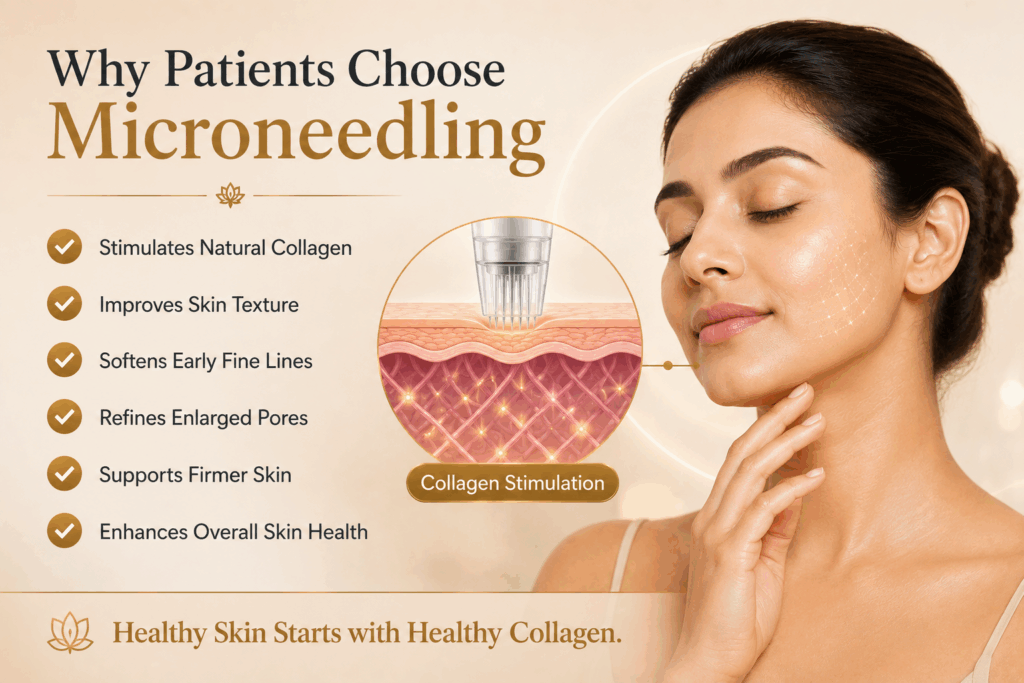
Most people don’t wake up one morning with wrinkles, enlarged pores, or uneven skin texture. The changes happen slowly.
You may first notice your skin looking dull in photographs. Makeup no longer sits smoothly. Acne scars become more noticeable under certain lighting. Your pores appear larger than they used to, or your skin simply doesn’t have the healthy glow it once did.
These are often early signs that your skin’s natural renewal process is slowing down.
One of the biggest reasons behind these visible changes is a gradual decline in collagen production. Collagen is the structural protein responsible for keeping skin firm, smooth, and resilient. As collagen levels decrease with age and environmental damage, the skin begins to lose its strength, elasticity, and ability to repair itself efficiently.
This is exactly why dermatologists often recommend microneedling for skin rejuvenation. Rather than temporarily covering skin concerns, microneedling works by encouraging your skin to rebuild itself naturally through collagen stimulation—making it one of the most versatile treatments for long-term skin health.
Treatment outcomes vary based on factors such as age, skin type, scar severity, lifestyle, sun exposure, smoking habits, skincare routine, and adherence to post-treatment care. During consultation, we evaluate each of these factors before recommending a personalized treatment plan. Our focus is always on improving overall skin health while maintaining natural-looking results.
Microneedling (also known as collagen induction therapy) is a procedure in which a medical-grade device creates thousands of precise micro-channels in the skin. Your body recognizes these controlled micro-injuries and immediately begins its natural healing response.
Over the following weeks, fibroblast cells produce fresh collagen and elastin, gradually rebuilding the skin’s internal support structure through a process called neocollagenesis and dermal remodeling. This wound healing cascade stimulates Type I and Type III collagen synthesis, elastin production, and extracellular matrix remodeling—contributing to healthier skin long after the session is complete.
Because collagen develops gradually, the benefits of [Microneedling Treatment in Chennai] continue well beyond the treatment itself.
Collagen acts like the support framework beneath your skin. When collagen levels are healthy, the skin appears smooth, firm, even, elastic, and youthful. As production slows naturally with age and photoaging, you may notice fine lines, uneven texture, enlarged pores, more visible acne scars, loss of firmness, and a dull complexion.
Most topical creams cannot replace lost collagen — which is why many people invest in skincare products without seeing meaningful improvement. Microneedling takes a different approach: rather than applying collagen to the surface, it encourages your body to produce new collagen from within.
As collagen production increases, the skin surface gradually becomes more refined. Patients who seek microneedling because their skin feels rough, uneven, or dull often report skin that is softer, more even, better hydrated, and smoother to the touch. Improved texture is one of the most commonly observed early benefits.
The most valuable benefit of microneedling isn’t an immediate glow—it’s collagen. Healthy collagen influences nearly every aspect of youthful skin: firmness, elasticity, skin thickness, texture, and healing ability. Unlike treatments that create temporary improvements, collagen induction therapy supports the body’s own repair mechanisms for long-term results.
Fine lines rarely appear suddenly — they usually begin with subtle collagen loss. Patients may first notice smile lines becoming more visible, makeup settling into fine lines, skin feeling thinner, or reduced firmness. Because microneedling supports collagen remodeling, it is commonly included in non-surgical [Anti-Ageing Treatments] plans. The goal is not to dramatically change your appearance, but to help maintain healthier, firmer skin naturally.
Pores cannot be permanently closed. However, healthier collagen around the pore walls can improve skin support, making enlarged pores appear less noticeable over time. Many patients report smoother-looking skin after compappearance butalized microneedling plan.
Healthy skin is constantly renewing itself, but this process slows over time. Microneedling encourages the skin’s repair response, supporting healthier regeneration and improving overall skin quality. Patients often describe their skin as looking fresher, brighter, healthier, and more even—rather than simply “glowing.” True skin rejuvenation is about healthier skin, not temporary cosmetic effects.
One of the most established uses of microneedling is improving the appearance of atrophic acne scars. Collagen remodeling gradually supports the skin beneath scarred areas, which may improve rolling scars, boxcar scars, and mild textural irregularities. Treatment recommendations vary depending on scar type, depth, and overall skin condition, making a professional assessment essential.
Dermatologists continue recommending microneedling because it focuses on improving skin quality rather than masking concerns. Healthy skin has better resilience, improved texture, more even tone, stronger collagen support, and enhanced elasticity. Microneedling encourages gradual improvements that contribute to healthier skin over time — not quick cosmetic fixes.
As collagen production slows with age, the skin gradually loses its natural firmness. This is often when people begin noticing a softer jawline, mild cheek laxity, or skin that doesn’t feel as elastic as before. Microneedling supports the skin’s natural collagen-building process, which may improve firmness over time. It is a popular choice for people seeking non-surgical skin rejuvenation with natural-looking improvements.
An even skin tone plays a major role in how fresh and youthful your skin looks. Sun exposure, pollution, previous acne, and everyday environmental stress can all contribute to uneven-looking skin and photoaging. As microneedling supports healthier skin renewal, many patients notice improvements in overall skin clarity and smoothness. For certain pigmentation concerns, dermatologists may combine microneedling with other treatments as part of a broader plan.
One of the biggest advantages of microneedling is that it doesn’t focus on just one problem. Healthier collagen supports better skin texture, improved firmness, more even skin tone, greater elasticity, a smoother skin surface, and a stronger skin barrier — including improvements in transepidermal water loss (TEWL) and skin barrier function. This comprehensive improvement is why microneedling remains one of the most recommended dermatological treatments.
Microneedling is supported by clinical evidence for improving various skin concerns. Peer-reviewed dermatology research has shown that collagen induction therapy may improve skin texture, atrophic acne scars, photoaged skin, and overall dermal remodeling. Controlled micro-injuries stimulate fibroblast activity, collagen synthesis (Type I and Type III collagen), elastin production, growth factor release, and extracellular matrix remodeling — contributing to healthier skin over time.
Treatment effectiveness depends on individual skin characteristics, treatment depth, treatment intervals, and professional technique. Consultation with a qualified dermatologist remains essential before beginning treatment.
Medical References: American Academy of Dermatology (AAD) · American Society for Dermatologic Surgery (ASDS) · Journal of Clinical and Aesthetic Dermatology · International Journal of Dermatology · Journal of Cosmetic Dermatology
Microneedling may be suitable for individuals with:
Suitability should always be determined following an in-person dermatological evaluation.
Microneedling may not be recommended for individuals with:
Your dermatologist will review your full medical history before recommending treatment.
Professional microneedling is generally considered safe when performed by qualified dermatologists. Temporary side effects may include mild redness, swelling, skin tightness, dryness, temporary sensitivity, light peeling, and minor pinpoint bleeding immediately after treatment. Although uncommon, infection, prolonged inflammation, or post-inflammatory hyperpigmentation may occur if aftercare instructions are not followed, or if treatment is performed improperly.
Following appropriate aftercare helps support skin healing and collagen remodeling. Patients are commonly advised to:
A common question during consultation is: “If I already use quality skincare, why would I need microneedling?”
Skincare products primarily work on or near the skin’s surface. Microneedling focuses on stimulating your skin’s natural repair mechanisms beneath the surface by encouraging collagen production. For many people, skincare and dermatologist-guided treatments work best together — not as replacements for one another.
These two treatments work differently and are not competing options.
Microneedling focuses on stimulating collagen production and supporting skin remodeling from within. It is commonly used for texture improvement, acne scars, pores, and skin rejuvenation.
[Chemical Peel Treatment] primarily exfoliate the outer layers of the skin and are often recommended for superficial pigmentation, uneven tone, and improving skin brightness.
Rather than choosing one over the other, they can sometimes complement each other when planned by a dermatologist.
Home derma rollers have become widely available, but they are not designed to replace professional microneedling. Dermatologist-performed microneedling offers several clear advantages: medical-grade devices, sterile treatment protocols, customized needle depths based on skin concerns, personalized treatment planning, clinical assessment before treatment, and professional aftercare guidance. Every patient’s skin is different, which is why professional assessment plays an essential role in both safety and outcomes.
Depending on your skin concerns, your dermatologist may recommend microneedling alongside or instead of the following treatments:
Choosing the right treatment is always more important than choosing the most popular one.
At Venus Skin Clinic, microneedling is never a one-size-fits-all procedure. Every treatment begins with a detailed skin evaluation to understand your skin type, primary concerns, scar or pigmentation patterns, lifestyle factors, previous treatments, and long-term skin goals.
Based on this assessment, a dermatologist develops a personalized treatment plan focused on achieving healthier skin — not simply performing a procedure. Our goal is to help patients improve skin texture, firmness, acne scars, overall skin quality, and long-term skin health.
The answer depends on your skin concerns and expectations. Microneedling is not designed to deliver dramatic overnight changes. It focuses on gradual, natural improvements by supporting your skin’s own repair process. Patients who understand that skin rejuvenation is a process — not a one-day transformation — are consistently the most satisfied with their results.
What are the main benefits of microneedling?
Microneedling supports collagen production, helping improve skin texture, firmness, enlarged pores, acne scars, and overall skin rejuvenation.
Does microneedling increase collagen?
Yes. Microneedling is also known as collagen induction therapy because it stimulates the body’s natural collagen production as part of the skin’s healing process.
Is microneedling good for anti-aging?
Yes. It is commonly included in non-surgical anti-aging treatment plans because it supports collagen remodeling and helps improve early signs of skin aging.
Can microneedling reduce enlarged pores?
While pores cannot be permanently closed, healthier collagen around the skin may help make enlarged pores appear less noticeable.
Does microneedling improve skin texture?
Yes. Improved collagen production can contribute to smoother, more even skin texture over time.
How many sessions are usually recommended?
The number of sessions varies by skin concern. Mild rejuvenation may require fewer sessions, while acne scar treatment often involves multiple treatments spaced several weeks apart.
When can I expect to see results?
Initial improvements may become noticeable within a few weeks, while collagen remodeling continues for several months following treatment.
Can microneedling be combined with PRP?
Yes. In selected patients, dermatologists may combine microneedling with Platelet-Rich Plasma (PRP) to support healing and collagen production.
Does microneedling hurt?
A topical anesthetic cream is applied before treatment to improve comfort. Most people describe the procedure as tolerable.
Is there downtime?
Most patients experience mild redness similar to a mild sunburn for 24–72 hours, depending on treatment intensity and individual skin response.
Can microneedling treat pigmentation?
It may be incorporated into treatment plans for selected pigmentation concerns, depending on the specific diagnosis and skin type.
Can all skin types undergo microneedling?
Yes, when treatment settings are customized by an experienced dermatologist.
How long does a session take?
Most sessions last approximately 30–60 minutes, depending on the treatment area.
Can I wear makeup afterward?
Most dermatologists recommend avoiding makeup for at least 24 hours after treatment.
How often should microneedling be repeated?
Treatment intervals commonly range from 4–6 weeks, determined by your dermatologist based on your skin goals.
Is microneedling worth it for skin rejuvenation?
For suitable candidates seeking gradual, natural improvements in skin quality, microneedling can be an effective part of a dermatologist-guided skin rejuvenation plan.
Healthy skin isn’t created by chasing trends — it comes from supporting the skin’s natural ability to repair and renew itself.
The true benefits of microneedling go beyond a temporary glow. By stimulating collagen production, improving skin texture, supporting firmness, refining the appearance of pores, and promoting overall skin health through neocollagenesis and dermal remodeling, microneedling offers a science-backed approach to long-term skin rejuvenation.
When combined with a personalized treatment plan and expert dermatological care, it can help you achieve healthier, smoother, and more confident-looking skin over time
Discover whether microneedling is the right treatment for your skin.
📍 Venus Skin Clinic – Chennai
🌐 www.venusskinclinic.com[Acne Scar Treatment][Acne Scar Treatment][Anti-Ageing Treatments][Chemical Peel Treatment]
 What Is Microneedling? A Complete Beginner’s Guide to Healthier, Smoother Skin
 Find the Best Dermatologists in Nungambakkam, Chennai – Venus Skin Clinic
 Best Skin Clinic in Chennai: Advanced Treatments & Expert Dermatologists
 Skin Doctor in Avadi: Your Complete Guide to Healthier, Glowing Skin
 Skin Doctor Near Ramapuram: Your Guide to Healthier, Glowing Skin
 Skin Doctor in OMR: Your Guide to Healthier, Glowing Skin
 Chemical Peel Benefits: Rejuvenate Your Skin with This Effective Treatment
 ✨ Discover the Life-Changing Glutathione IV Benefits at Venus Skin Clinic, Chennai
 Ultimate Guide to Skin Whitening Treatments in Chennai: Costs, Benefits, and Expert Tips
 PRP Hair Treatment for Hair Loss at Venus Skin Clinic: Your Solution to Fuller, Healthier Hair
 Is Glutathione IV Safe? What Dermatologists Want You to Know
 Consult Dermatologists Online: The Future of Skincare at Your Fingertips
