
HIFU treatment in Chennai is a non-surgical skin-tightening procedure that uses focused ultrasound energy to stimulate tissue remodeling and collagen production. HIFU treatment for the face may help improve the appearance of mild to moderate skin laxity and facial definition without surgery or significant downtime. Results develop gradually and vary between individuals. A qualified dermatologist should assess your skin, treatment goals, and suitability before recommending HIFU.
Loose skin, a less-defined jawline, or early signs of facial aging can be frustrating, especially when you aren’t ready for surgery. That’s where non-surgical skin-tightening treatments such as HIFU have attracted attention.
HIFU treatment in Chennai uses focused ultrasound energy to target selected tissue layers beneath the skin. The controlled thermal effect can stimulate collagen remodeling and may gradually improve the appearance of skin firmness and facial definition.
But HIFU isn’t simply a “facelift without surgery,” and the result isn’t identical for everyone. The outcome depends on your age, degree of skin laxity, facial anatomy, treatment area, device, treatment settings, and the experience of the practitioner.
This guide explains what HIFU treatment is, how HIFU treatment for the face works, who may benefit, what the procedure feels like, expected results, possible side effects, and what to consider when choosing a clinic in Chennai.
Quick answer: HIFU treatment is a non-surgical ultrasound-based procedure used to improve the appearance of mild to moderate skin laxity. For appropriately selected patients, it can support firmer-looking skin and improved facial contours without surgical incisions or significant downtime.
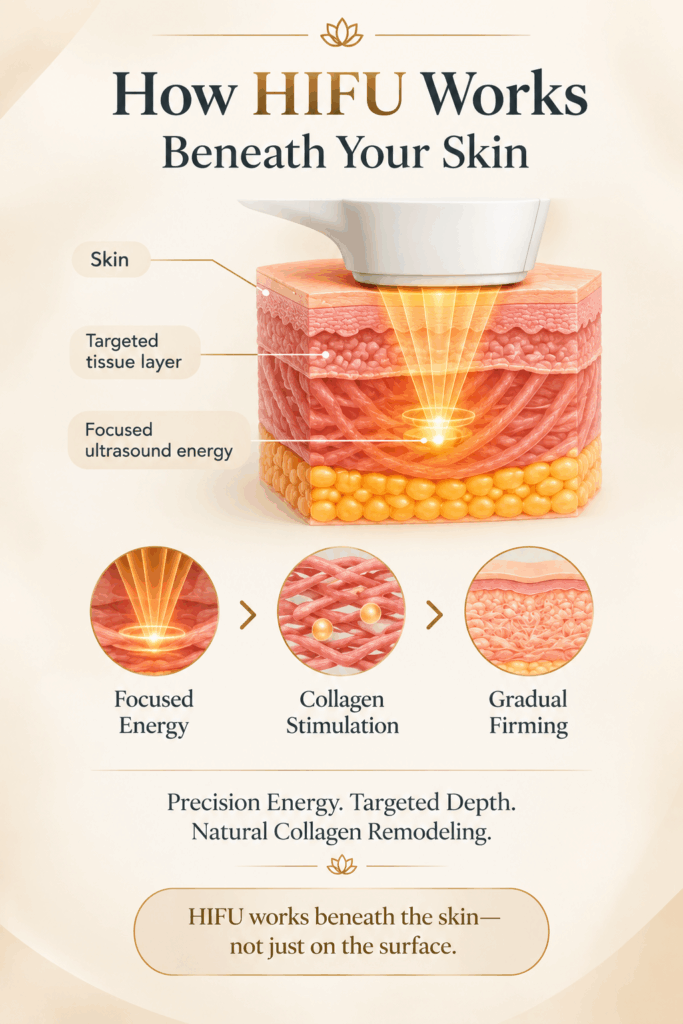
HIFU stands for High-Intensity Focused Ultrasound. Unlike conventional cosmetic procedures that primarily work at the surface of the skin, focused ultrasound can deliver energy to selected deeper tissue layers.
At the treatment point, ultrasound energy creates controlled thermal effects. This stimulates a healing and remodeling response involving collagen. Over time, changes in collagen structure can contribute to a firmer appearance.
Clinical research supports the use of microfocused ultrasound and related focused-ultrasound technologies for facial skin tightening, particularly in people with mild to moderate laxity. However, studies use different devices, treatment parameters, and assessment methods, so results shouldn’t be presented as identical across every HIFU machine or clinic.
A simplified way to understand HIFU is the following:
Ultrasound energy → controlled thermal stimulation → tissue remodeling → collagen changes → gradual improvement in firmness
The treatment doesn’t simply “pull” the skin upward immediately. Much of the visible improvement develops gradually as the body’s remodeling response progresses.
A 2025 systematic review covering 45 clinical trials and cohort studies found evidence of skin-tightening effects, particularly around the lower face, neck, and periorbital areas, while also highlighting differences in treatment protocols and the need for better standardization.
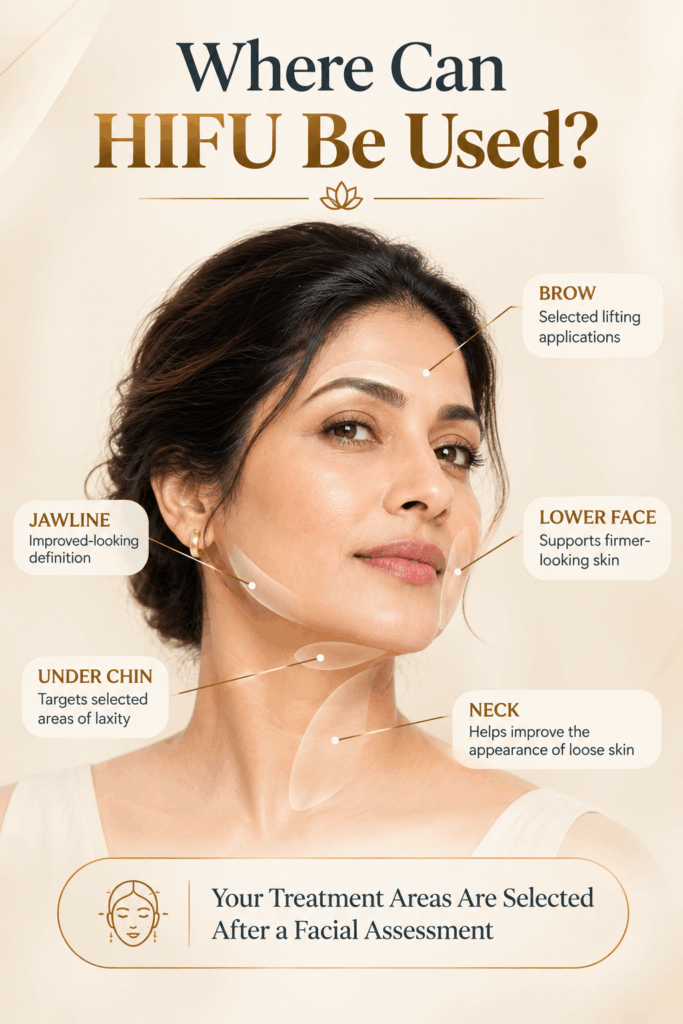
HIFU treatment for the face is generally considered when the main concern is mild to moderate skin laxity rather than severe excess skin.
Common treatment areas can include:
The exact areas treated should be decided after examining your facial anatomy rather than simply following a standard treatment map.
It may help improve the appearance of a less-defined jawline when skin laxity is an important contributing factor.
However, jawline definition isn’t determined by skin alone. Bone structure, facial fat distribution, muscle anatomy and the amount of loose skin all influence the result.
HIFU isn’t primarily a wrinkle treatment in the same way that some resurfacing or injectable treatments are. Its main aesthetic role is generally related to tightening and lifting.
Some studies have reported improvements in wrinkles and overall facial appearance following focused ultrasound treatment, but individual outcomes vary.
HIFU may be considered for adults who have visible but relatively mild to moderate skin laxity and want a non-surgical treatment.
You may be a potential candidate if:
HIFU may be less suitable when there is substantial excess skin or when the desired result requires a major structural lift. Research also suggests that outcomes can be less predictable as the degree of laxity increases.
A clinician should review your medical history, skin condition, and facial anatomy before proceeding. Particular caution may be needed depending on factors such as active skin conditions, infections, implanted devices, or other medical circumstances.
Don’t rely solely on an online eligibility checklist. Suitability is ultimately an individual clinical decision.
For readers comparing treatments, an internal link could be added here to a “Non-Surgical Facelift Options” guide.
One advantage of HIFU is that treatment generally doesn’t require surgical incisions.
A typical appointment may involve the following steps.
The practitioner examines the skin, degree of laxity, and areas of concern. This is also the stage where you should discuss your expectations.
The treatment area and appropriate energy delivery parameters are selected according to the device, anatomy, and treatment objective.
The skin is cleaned and prepared before the ultrasound handpiece is applied.
The device delivers focused ultrasound energy to selected depths. Depending on the system used, treatment may involve multiple lines or pulses across different areas.
Your clinician should explain what sensations or temporary reactions to expect and provide appropriate aftercare instructions.
People may experience warmth, tingling, pressure, or brief pulses of discomfort during treatment. Pain levels vary according to individual sensitivity, treatment area, device, and settings.
A 2023 meta-analysis of microfocused ultrasound studies reported an average pain score of approximately 3.1 on a 10-point scale, although individual experiences can differ considerably.
If you’re particularly sensitive to discomfort, discuss this before treatment rather than assuming that every HIFU session feels the same.
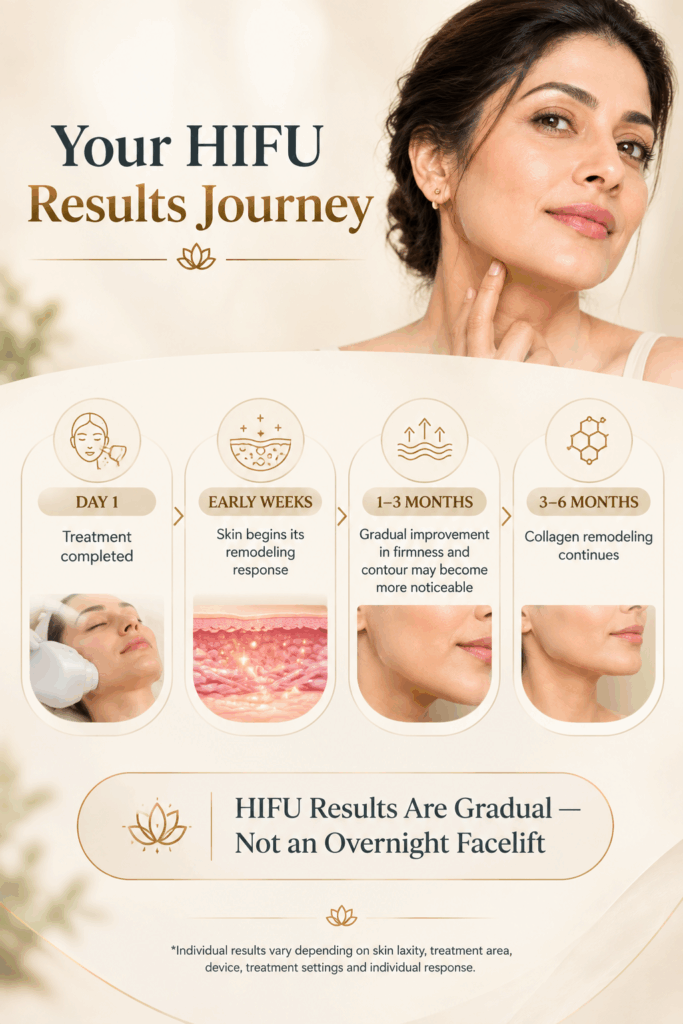
One of the biggest misconceptions about HIFU is expecting an instant facelift.
HIFU results generally develop gradually.
Some patients may notice an early change in firmness or contour, but the more meaningful remodeling effect develops over time.
Research on microfocused ultrasound has reported improvement in facial skin tightening at follow-up periods such as three and six months, although study results vary and longer-term evidence remains limited.
There isn’t one guaranteed duration that applies to everyone.
Your result can depend on:
A recent systematic review also identified variation between HIFU platforms and treatment protocols, reinforcing why a treatment plan shouldn’t be based only on the machine’s brand name.
Think of HIFU as a treatment that works with the skin’s existing ability to remodel tissue. If someone has a small amount of laxity and good skin quality, a modest tightening effect may be noticeable.
If someone has extensive loose skin, HIFU alone may not provide the degree of lifting they expect.
That difference should be discussed before treatment—not after.
HIFU is non-surgical, but non-surgical doesn’t mean risk-free.
Temporary effects can include:
Less common complications have also been reported, including altered sensation, bruising, and other tissue effects. The risk depends partly on treatment technique, energy settings, anatomy, and the device being used.
A 2025 systematic review described a generally favorable safety profile for aesthetic HIFU while noting that standardized treatment protocols remain an important area for improvement.
Most people don’t require the type of recovery associated with surgery. However, temporary tenderness, redness, or swelling can occur.
Your clinician should give you specific post-treatment instructions based on the device and treatment performed.

The face contains important nerves, blood vessels, fat compartments, and other anatomical structures. Treatment should therefore be planned around anatomy rather than simply applying energy everywhere.
When researching HIFU treatment in Chennai, ask:
These questions can tell you more about a clinic’s approach than promotional claims about being the “best” HIFU center.
Chennai has a wide range of aesthetic and dermatology clinics, so comparing providers can be confusing.
Don’t choose solely on price.
Ideally, your treatment should begin with an appropriate clinical assessment rather than an immediate sales consultation.
For aesthetic procedures, a dermatologist with relevant training and experience can help determine whether HIFU is appropriate or whether another treatment would better address your concern.
“HIFU” is a broad category, and different systems can have different technical characteristics. Published literature has identified considerable variation in frequency, focal depth, energy and treatment parameters among ultrasound platforms.
Ask the clinic for:
When searching for HIFU treatment cost in Chennai, remember that pricing can vary according to the following:
A very low advertised price may not represent the same treatment protocol as a higher quotation.
HIFU isn’t automatically the best treatment for every type of aging concern.
| Treatment Approach | Common Goal | Main Consideration |
|---|---|---|
| HIFU / Focused Ultrasound | Skin tightening and lifting | Best suited to selected degrees of laxity |
| Radiofrequency | Skin tightening and texture support | Works through controlled radiofrequency heating |
| Laser Treatments | Texture, pigmentation and selected skin concerns | Results depend heavily on laser type and skin condition |
| Dermal Fillers | Restoring or enhancing facial volume | Primarily addresses volume rather than general skin laxity |
| Surgical Facelift | More significant lifting | More invasive, with surgical recovery |
The right option depends on what is actually causing the visible concern.
For example, a patient who says, “My face looks tired,” may actually have volume loss rather than simply loose skin. Another patient may have predominantly skin laxity. These two situations shouldn’t automatically receive the same treatment.
A dermatologist can help distinguish between skin laxity, volume loss, pigmentation, wrinkles, and changes in facial contour before recommending a procedure.
HIFU may be useful for selected people with mild to moderate facial skin laxity. It can support a firmer appearance and improve aspects of facial contour, but it doesn’t provide the same degree of lifting as surgery.
The number of sessions depends on the treatment device, treatment area, degree of laxity, and individual response. Some clinical studies have evaluated single treatments, while clinical practice may use different treatment schedules. Your practitioner should recommend a schedule based on your skin rather than a fixed number for everyone.
HIFU has a generally favorable safety profile when appropriately selected and performed, but side effects and complications are possible. Temporary redness, swelling, tenderness, or altered sensation can occur. Proper assessment and technique are important.
HIFU results are usually gradual. Some changes may be noticed earlier, while collagen remodeling continues over subsequent weeks and months. The timing varies between patients.
HIFU and a surgical facelift serve different purposes. HIFU is a non-surgical option for selected degrees of skin laxity, while surgery can address more significant excess skin and tissue changes. HIFU should not be marketed as equivalent to a facelift.
HIFU treatment in Chennai can be a useful non-surgical option for selected adults with mild to moderate skin laxity who want gradual improvement in firmness and facial definition. It works by delivering focused ultrasound energy to targeted tissue layers and stimulating a remodeling response.
The most important decision isn’t simply finding the cheapest HIFU session. It’s finding a qualified practitioner who can determine whether HIFU is appropriate for your anatomy, choose an appropriate treatment strategy, and explain realistic outcomes.
If you’re considering HIFU treatment for face, start with a professional consultation. Ask about the device, treatment depth, expected results, possible risks, and alternatives. If HIFU isn’t the right option for your concern, an experienced dermatologist should be able to explain what may work better.
 Anti-Aging Treatment in Chennai: A Complete Guide to Younger-Looking Skin with RF Skin Tightening and Forehead Lines Removal
 HIFU Treatment for Face in Chennai: Benefits, Procedure, Cost, Side Effects & Results | Complete 2026 Guide
 HIFU Treatment in Chennai: Benefits, Cost, Recovery, Results & Everything You Need to Know (2026 Guide)
 Skin Care Clinic in Chennai: Your Complete Guide to Long-Term Skin Health
 Skin Care Specialist in Chennai: Complete Dermatologist Guide for Healthy, Problem-Free Skin
 Finding the Best Dermatologist Near You in Chennai: A Complete Guide to Glowing Skin
 Microneedling for Face: Complete Guide to PDRN Treatment in Chennai — Benefits, Process & Pricing
 HIFU Skin Tightening Treatment in Chennai
 Skin Doctor in Avadi: Your Complete Guide to Healthier, Glowing Skin
 What Is Microneedling? A Complete Beginner’s Guide to Healthier, Smoother Skin
 Face Lifting Treatment Price in Chennai (2026): Complete Cost Guide, Procedure & What Influences the Price
 How Many HIFU Sessions Are Needed? A Realistic Guide for First-Time Patients
