Medically Reviewed By: Dr. Sharanya Karthik, MBBS, MD, DVL, Consultant Cosmetic Dermatologist, Venus Skin Clinic, Chennai
Experience: 11+ years in dermatology and aesthetic skin treatments
Last Medical Review: September 2026
Published: September 2026
Last Updated: September 05, 2026
Medical disclaimer: This article is for general educational purposes and does not replace an individual dermatology consultation. Suitability, treatment technique, product selection, expected results and risks vary from person to person.September
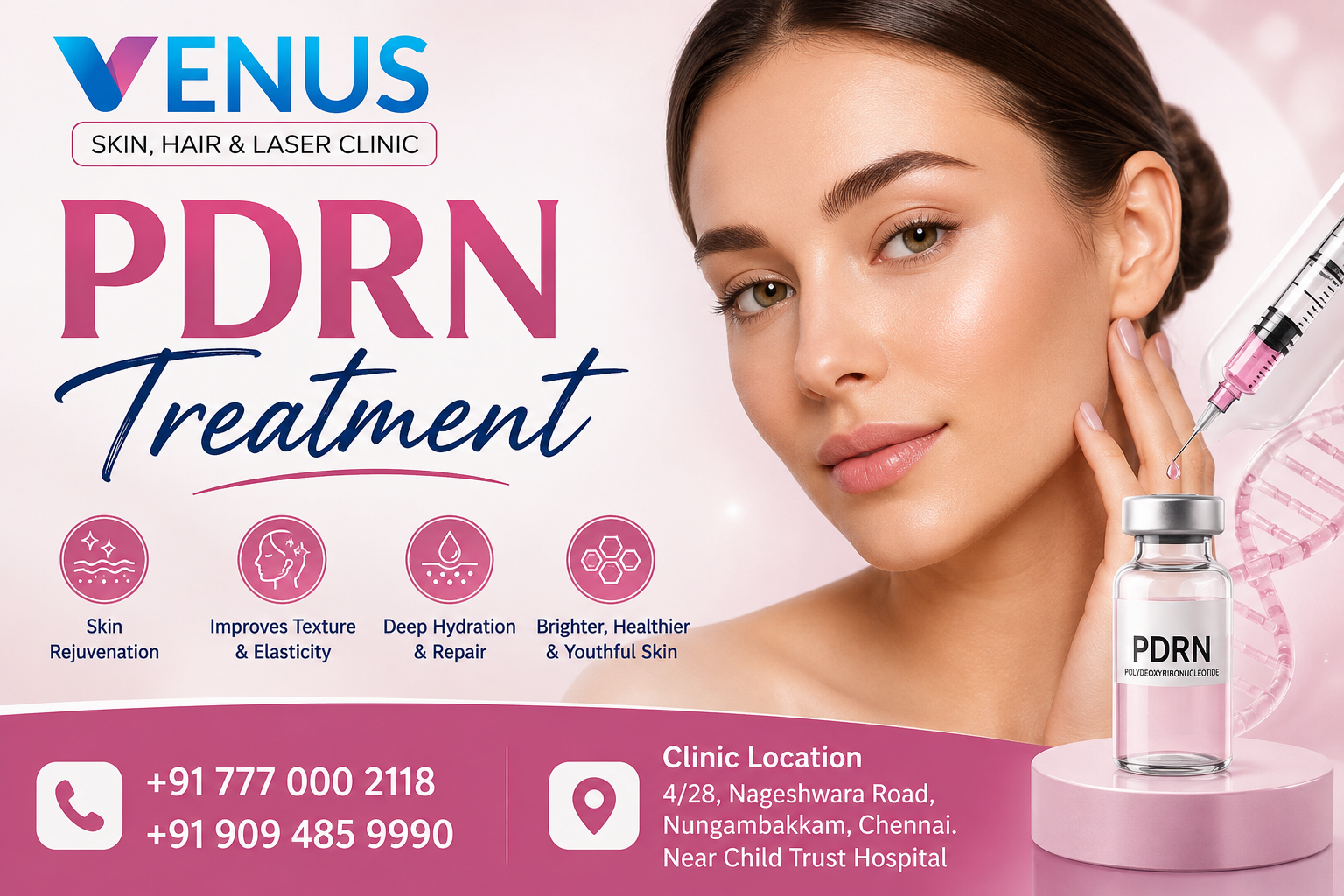
PDRN treatment in Chennai is a skin-rejuvenation treatment that uses polydeoxyribonucleotide (PDRN), a DNA-derived biomaterial studied for tissue repair and regenerative effects. In aesthetic dermatology, PDRN may be used as part of treatment plans intended to improve aspects of skin quality such as texture, hydration, and elasticity. Depending on the product, technique, and clinic, the indicative cost in Chennai can range from about ₹5,500 to ₹18,000+ per session.
There isn’t one standard price or one treatment protocol. Current Chennai listings illustrate the variation: one clinic advertises treatment from ₹5,500 per session, another lists PDRN at ₹7,000, while Venus Skin Clinic gives an indicative range of ₹9,000–₹15,000 per session.
Clinical evidence for PDRN and related polynucleotide treatments is encouraging but still developing. Recent systematic evidence has reported improvements in areas such as wrinkles, scar quality, and skin-rejuvenation outcomes, but studies are relatively small and use different products and protocols.
PDRN treatment uses polydeoxyribonucleotide, a purified DNA-derived material investigated for tissue repair and regeneration. PDRN has been studied for its effects on cell migration, tissue repair, inflammation, and extracellular-matrix activity.
An indicative PDRN treatment cost in Chennai is approximately ₹5,500–₹18,000+ per session. The actual price depends on the product, amount used, treatment area, delivery technique, dermatologist, and whether another procedure is included. Current Chennai listings support this broad variation.
No. PDRN is the treatment material, while microneedling is a procedure that creates controlled micro-injuries in the skin. Selected protocols may combine PDRN with microneedling or other aesthetic procedures, but they are not the same treatment.
There is no single session schedule that applies to everyone. The number of sessions depends on the patient’s skin concern, product, treatment method, and clinical goals. Research protocols also vary considerably.
No. A dermatologist should assess your skin, medical history, current medications, and treatment goals before recommending PDRN.
If your concern is dull, tired-looking skin, mild loss of elasticity, fine lines, or uneven texture, you may have come across PDRN treatment while researching newer skin-rejuvenation procedures.
PDRN stands for polydeoxyribonucleotide. It consists of purified DNA fragments and has a research history in tissue repair and regenerative medicine. Studies have proposed that PDRN works partly through adenosine A2A receptor activation and the nucleotide salvage pathway, mechanisms associated with tissue repair, cell activity, and modulation of inflammation.
In cosmetic dermatology, the conversation is somewhat different from its established regenerative-medicine research. PDRN and related polynucleotide products are being investigated for their possible role in improving skin quality and supporting recovery after aesthetic procedures.
A recent 2026 systematic review identified seven randomized trials involving 183 participants across skin rejuvenation, scar prevention, and wound healing. The review found encouraging results, but the authors also highlighted the small evidence base and variation between studies.
That distinction matters. PDRN is promising, but it should not be presented as a guaranteed anti-ageing treatment or a replacement for every established dermatological procedure.
Internal linking opportunity: Link “What Is PDRN Treatment?” to a dedicated PDRN treatment guide.
One of the most searched questions is simple: How much does PDRN treatment cost in Chennai?
The honest answer is that the price varies.
Based on current publicly listed Chennai prices, patients may encounter figures ranging from roughly ₹5,500 to ₹18,000+ per session, depending on the treatment and clinic. Anucare Aesthetic & Wellness Centre in Anna Nagar lists PDRN treatment from ₹5,500 per session, while another Chennai clinic currently lists PDRN at ₹7,000. Venus Skin Clinic gives an indicative range of ₹9,000–₹15,000 per session.
| Treatment Consideration | Indicative Price/Impact |
|---|---|
| Basic PDRN Session | Around ₹5,500–₹12,000+ |
| Premium Formulation/Protocol | Around ₹12,000–₹18,000+ |
| Larger Treatment Area | May Increase Cost |
| PDRN with Another Procedure | Depends on the Additional Procedure |
| Multiple-Session Treatment | Total Cost Depends on the Recommended Number of Sessions |
These figures should be treated as indicative only, not as an official Chennai-wide price.
Two clinics can quote very different amounts because the treatment isn’t necessarily identical.
Before comparing prices, ask:
For example, comparing a ₹7,000 PDRN procedure with a ₹14,000 protocol isn’t meaningful unless you know what is included in each.
The lowest quoted price isn’t necessarily the lowest total treatment cost.
PDRN is primarily discussed as a skin-quality and tissue-repair treatment, rather than a traditional filler that adds facial volume.
PDRN may be considered when the goal is improving the overall quality and feel of the skin.
Clinical studies of PDRN and related polynucleotide treatments have reported improvements in wrinkle-related outcomes. However, the evidence remains limited, so expectations should be realistic.
Some aesthetic research has reported improvements in elasticity and skin-quality measures following polynucleotide treatments.
This is one of PDRN’s better-established areas of research. Reviews describe biological effects involving tissue repair, cell migration, angiogenesis, and inflammation-related pathways.
A 2026 narrative review examining PDRN in aesthetic medicine reported clinical evidence suggesting possible benefits in post-procedure recovery, including re-epithelialization, erythema, and scarring. The review also emphasized limitations such as small studies, formulation differences, and limited long-term data.
This is why a good consultation starts with the actual skin problem, not with a trendy treatment name.
Someone with significant melasma may need a pigmentation-focused plan. Someone with deep acne scars may need scar-directed treatment such as microneedling, fractional resurfacing, or another procedure. PDRN may be an adjunct in selected cases rather than the main treatment.
Internal linking opportunity: Link “PDRN Treatment Benefits” to a detailed benefits article.
These terms are sometimes used together online, but they describe different things.
Microneedling for the face is a procedure. A device containing fine needles creates controlled micro-injuries in the skin, triggering a wound-healing response.
PDRN treatment refers to the use of polydeoxyribonucleotide as the active treatment material.
So, in simple terms:
Microneedling is a procedure; PDRN is a treatment material.
Selected aesthetic protocols may combine them. Recent literature has explored PDRN in combination with physical procedures, including microneedling, particularly in the context of skin repair and recovery.
Microneedling is commonly discussed for concerns such as:
PDRN may be considered when the treatment goal is more focused on skin quality, tissue repair, and regenerative support.
The two can complement each other in selected treatment plans, but that doesn’t mean combining them is automatically better for everyone.
The exact technique depends on the product and clinical protocol.
A dermatologist first examines your skin and discusses your concerns.
This step helps determine whether PDRN makes sense for your problem or whether another treatment would be more appropriate.
The skin is cleansed and prepared. Depending on the technique, topical anesthetic may be used to improve comfort.
Depending on the protocol, PDRN may be delivered through small injections or used as part of a clinician-selected skin-delivery procedure.
The delivery method should not be chosen solely because it is popular on social media. The product, depth, quantity, and technique need to match the intended treatment.
Temporary redness, swelling, tenderness, or small raised areas can occur, particularly after injectable procedures.
Your dermatologist should provide specific instructions regarding skincare, sun protection, exercise, and other activities following the treatment.
There isn’t a universal answer.
The recommended number of sessions can depend on:
Research studies themselves have used different treatment schedules, which is another reason a personalized plan is preferable to copying a fixed package advertised elsewhere.
Usually, PDRN should not be approached as an instant transformation.
Patients seeking skin-quality improvements should generally expect changes to develop over time rather than assuming that one session will produce a dramatic result.
The result can also depend on the concern being treated. Someone seeking improved hydration may perceive a change differently from someone being treated for fine lines or textural irregularities.
A responsible consultation should explain:
What can improve? → How long it may take → How many sessions may be considered → What results aren’t realistic.
PDRN has a substantial research history in regenerative medicine, but aesthetic treatment deserves its own discussion because products, indications, and delivery techniques can differ.
Recent clinical reviews have generally reported favorable tolerability, while commonly described local effects include redness, swelling, discomfort, or bruising. The 2026 systematic review of randomized trials found no serious treatment-related adverse events in its included studies, but it also emphasized the limited sample size and heterogeneity of available evidence.
Before treatment, tell your dermatologist about relevant allergies, medications, bleeding problems, active skin infections, and previous reactions to cosmetic procedures.
A clinician may also advise postponing or avoiding treatment in particular circumstances, including certain infections or other conditions where treatment could be inappropriate.
Safety should be assessed individually rather than inferred from a treatment’s popularity.
Choosing a PDRN clinic shouldn’t come down to price alone.
For an injectable or medical skin procedure, ask whether a qualified dermatologist is evaluating and performing the treatment.
“Salmon PDRN” or “skin booster” isn’t enough information for a meaningful comparison. Ask for the exact product and formulation being recommended.
A proper quote should make it reasonably clear whether the fee includes consultation, product, procedure, consumables, follow-up, and aftercare.
This is perhaps the most useful question.
A dermatologist should be able to explain:
“This is the skin problem we’re trying to address, this is why PDRN may help, and these are the alternatives.”
Suppose Clinic A quotes ₹8,000 but recommends four sessions, while Clinic B quotes ₹13,000 and recommends a different protocol with fewer visits.
Comparing ₹8,000 versus ₹13,000 alone tells you very little.
Compare the product, quantity, technique, practitioner, number of sessions, and follow-up plan.
Before paying for a package, ask these questions during your consultation:
1. What exact PDRN product will be used?
2. Why is this treatment suitable for my skin concern?
3. Will it be injected, microneedled, or delivered through another technique?
4. How many sessions do you expect me to need?
5. What results are realistic for my skin?
6. What side effects and downtime should I expect?
7. What is the total estimated cost, not just the per-session price?
These questions help you make a treatment decision based on clinical suitability rather than advertising claims.
PDRN treatment in Chennai may cost around ₹5,500 to ₹18,000+ per session. Current clinic listings vary substantially, so the final price should be confirmed after consultation. Product, quantity, treatment area, and technique can all affect the fee.
Neither is automatically better. PDRN and microneedling serve different purposes. Your dermatologist may recommend one or, in selected cases, combine them depending on whether your main concern is texture, acne scars, fine lines, skin quality, or repair.
There isn’t enough standardized evidence to promise one fixed duration for everyone. Results depend on the product, treatment protocol, skin condition, and individual response. Your dermatologist should explain the expected maintenance plan for your specific case.
Discomfort depends on the technique. Injectable PDRN can cause temporary stinging or tenderness, while topical numbing may be used to improve comfort. The experience varies by treatment method and individual sensitivity.
No. PDRN should not be described as a permanent pigmentation-removal treatment. Pigmentation has many causes, and treatment should begin with identifying the specific type of pigmentation.
This article is designed for people in Chennai who are researching PDRN before deciding whether to consult a dermatologist or book treatment.
It addresses three stages of the search journey:
Informational:
“What is PDRN treatment?”
“What does PDRN do for the skin?”
“Is PDRN safe?”
Commercial:
“How much does PDRN treatment cost in Chennai?”
“PDRN vs microneedling—which should I choose?”
“How many sessions are needed?”
Transactional:
“Where can I get PDRN treatment in Chennai?”
“Who should perform PDRN treatment?”
“How do I book a consultation?”
This intent structure allows the page to be useful to readers rather than repeating the same keyword throughout the article.
PDRN = Polydeoxyribonucleotide, a DNA-derived biomaterial with research involving tissue repair, regenerative processes, and inflammation-related pathways.
Polynucleotides are a related class of nucleic-acid-based materials increasingly discussed in aesthetic dermatology. They should not automatically be treated as identical to every PDRN formulation or product.
Microneedling for the face is a physical skin procedure using fine needles to create controlled micro-injuries. It is distinct from PDRN, although selected treatment protocols may combine the two.
Dr. Sharanya Karthik, MBBS, MD, DVL
Consultant Cosmetic Dermatologist, Venus Skin Clinic, Chennai
11+ years of experience in dermatology and aesthetic skin treatments.
Clear separation of these entities helps prevent an AI search system from incorrectly treating PDRN, polynucleotides, microneedling, and skin boosters as interchangeable terms.
The strongest claims on this page should be supported by peer-reviewed literature rather than relying entirely on clinic marketing content.
Recent evidence includes a 2026 systematic review of randomized clinical trials covering PDRN and polynucleotides in skin rejuvenation, scar prevention, and wound healing. It found promising outcomes but also identified a small evidence base and substantial protocol variation.
Earlier reviews describe PDRN’s proposed mechanisms through adenosine A2A receptor activity and the nucleotide salvage pathway, with research supporting effects related to tissue repair and regeneration.
A 2026 review specifically examined PDRN in post-procedure aesthetic recovery and reported encouraging human clinical evidence while highlighting limitations such as small sample sizes, formulation variability, and limited long-term follow-up.
For PDRN treatment costs in Chennai, clinic-published prices are useful only as current market examples, not as standardized medical pricing.
PDRN treatment uses polydeoxyribonucleotide, a DNA-derived biomaterial studied for tissue repair and regenerative skin applications.
Indicative Chennai pricing is approximately ₹5,500–₹18,000+ per session, depending on the product, amount used, technique, and clinic.
No. PDRN is a treatment material, while microneedling is a skin procedure.
It may be used in selected combination protocols, but the product and treatment method should be determined by a qualified clinician.
No. PDRN should not be marketed as a permanent treatment for pigmentation.
No. Treatment frequency and the number of sessions should be individualized.
PDRN treatment in Chennai can be an option for people looking for gradual improvements in skin quality, texture, hydration, or elasticity, but it isn’t a universal solution and shouldn’t be selected on price alone.
Current evidence is encouraging, particularly around tissue repair and selected skin-rejuvenation outcomes, but aesthetic research remains relatively early, and treatment protocols aren’t standardized.
Before choosing PDRN, find out what product will be used, how it will be delivered, why it is appropriate for your skin concern, how many sessions may be needed, and what the total expected cost will be.
The most useful next step is a consultation with a qualified dermatologist who can assess your skin and compare PDRN with options such as face microneedling or other skin-rejuvenation treatments. That approach helps you choose a treatment based on your actual skin concern rather than the popularity of a procedure.
