Medically Reviewed By: Dr. Sharanya Karthik, MBBS, MD, DVL, Consultant Cosmetic Dermatologist, Venus Skin Clinic, Chennai
Experience: 11+ years in dermatology and aesthetic skin treatments
Last Medical Review: August 2026
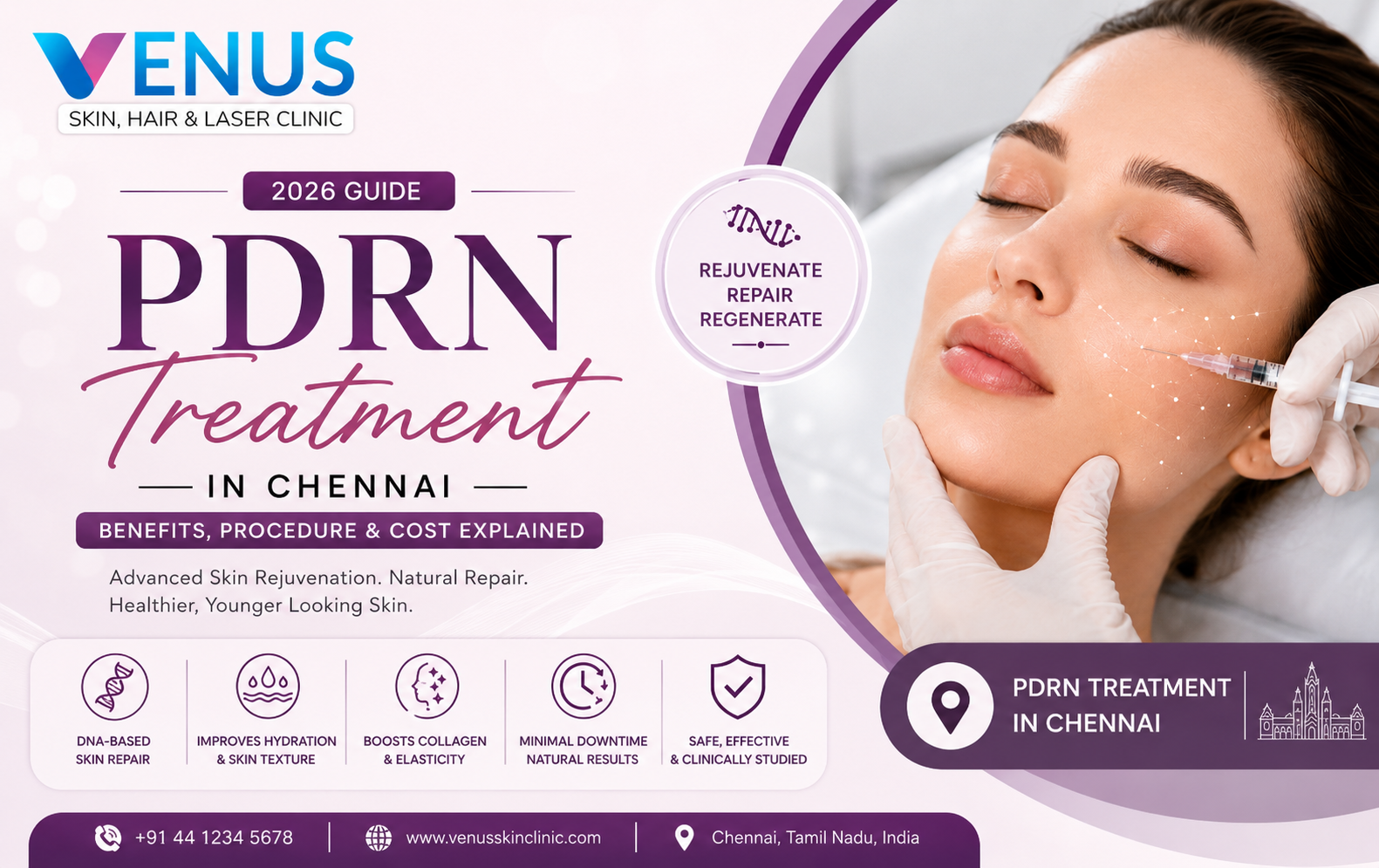
If your skin looks tired, dehydrated, less firm, or uneven despite following a good skincare routine, you may have come across PDRN treatment as a newer option for skin rejuvenation.
PDRN, short for polydeoxyribonucleotide, is a DNA-derived biomaterial that has been studied for tissue repair and regeneration. In aesthetic dermatology, it is increasingly used as an injectable or skin-delivery treatment intended to support skin quality rather than simply provide temporary surface hydration.
But is PDRN actually worth considering? How is it performed, how many sessions might you need, and what is the PDRN treatment cost in Chennai?
This guide explains how PDRN works, its potential benefits, the treatment process, recovery, safety considerations, expected results, and the factors that determine its price.
Medical Review Note: This article has been reviewed for medical accuracy, treatment expectations, safety considerations and patient suitability by Dr. Sharanya Karthik, Consultant Cosmetic Dermatologist, Venus Skin Clinic, Chennai. Individual treatment recommendations may vary after an in-person assessment.
PDRN treatment is a skin-rejuvenation procedure that uses polydeoxyribonucleotide to support tissue repair, skin quality, and regenerative processes.
PDRN consists of DNA fragments and has been investigated for its role in tissue repair, angiogenesis, inflammation, and cellular recovery. Research suggests that its biological effects include activation of adenosine-related pathways and support for fibroblast activity and extracellular-matrix processes.
In aesthetic practice, PDRN may be delivered through small injections into selected areas of the skin. Some protocols may also use PDRN-containing products alongside procedures such as microneedling or other skin-delivery techniques.
The important point is that PDRN isn’t a conventional dermal filler. It isn’t primarily intended to add facial volume or dramatically change facial contours. Its purpose is closer to supporting skin quality and regenerative processes.
The terms PDRN and PN, or polynucleotides, are sometimes used interchangeably in aesthetic marketing, but they are not technically identical.
Both are DNA-derived biopolymers, but they can differ in molecular size, composition, and biological characteristics.
If a clinic recommends a “PDRN” or “DNA” treatment, ask for the exact product name, formulation, and intended use before proceeding.
This is particularly important when comparing treatment prices because two clinics may use products that are marketed under similar terminology but have different formulations and protocols.
PDRN is generally considered a skin-quality treatment rather than a dramatic transformation procedure. Potential benefits depend on the person’s skin condition, the formulation used, and the treatment technique.
PDRN has been studied for its role in tissue repair and regeneration. Research suggests that it can influence biological pathways involved in cell activity, blood-vessel formation, and tissue recovery.
For aesthetic patients, this regenerative approach is one reason PDRN has attracted attention as a skin-rejuvenation treatment.
Some PDRN-based aesthetic protocols are intended to improve the appearance and feel of dry, rough, or tired-looking skin.
The expected change is usually subtle and progressive rather than an instant lifting effect. Skin may appear smoother or more hydrated as the treatment course progresses.
Research on PDRN indicates effects on fibroblast activity and extracellular-matrix processes, including pathways associated with collagen production.
This may contribute to improvements in skin firmness and texture, although the strength of evidence varies according to the formulation, indication, and clinical protocol.
As skin ages, collagen and elastin levels change, and the skin may gradually lose firmness.
A regenerative skin treatment may be considered for people concerned about early fine lines and reduced skin quality.
However, PDRN should not be presented as a replacement for treatments specifically designed to relax muscles, restore lost volume or resurface deeper wrinkles.
PDRN has a longer history of research in tissue repair and wound healing than in cosmetic skin rejuvenation.
This background helps explain the growing interest in PDRN within regenerative dermatology. However, evidence from wound-healing applications should not automatically be interpreted as proof that an aesthetic PDRN treatment will produce the same degree of benefit in healthy aging skin.
PDRN may be considered for adults who are primarily concerned about skin quality rather than facial volume.
A dermatologist may discuss it for concerns such as the following:
It may appeal to people who want gradual skin-quality improvement without undergoing surgery.
However, PDRN isn’t automatically the best treatment for every concern.
For example, someone with deep acne scars may benefit more from a combination of treatments such as microneedling, fractional laser, or subcision. Someone with significant pigmentation may require treatment directed at the underlying cause rather than a regenerative injectable alone.
A good consultation should begin with diagnosis and treatment goals, not with selling a particular procedure.
A dermatologist may postpone or avoid treatment depending on factors such as active skin infection, significant inflammation, certain allergies, pregnancy or breastfeeding considerations, bleeding risks, medications and other individual medical factors.
Your complete medical history should therefore be discussed before an injectable treatment.
The exact protocol varies between clinics and products, but an injectable PDRN session generally follows several stages.
The dermatologist first evaluates your skin, medical history, current skincare routine, and the concern you want to address.
This is important because dehydration, pigmentation, acne, rosacea, acne scarring and premature ageing can have very different causes.
The doctor decides whether PDRN is appropriate and which areas should be treated.
Depending on the patient’s concerns and the selected product, treatment may focus on areas such as:
The injection depth, quantity, and number of treatment points depend on the product and treatment plan.
The treatment area is cleansed carefully.
A topical numbing cream may be used when appropriate to reduce discomfort. Because the procedure involves multiple small injections, appropriate sterile technique is important.
The product is delivered into selected skin layers using multiple small injections.
Patients may describe the sensation as mild pinching or stinging. Temporary redness, small raised injection points, or mild swelling can occur immediately afterward.
Your dermatologist may recommend gentle skincare, adequate sun protection, and protection from irritating products for a short period.
Follow the specific aftercare instructions provided by your treating clinician because recommendations can vary depending on the injection technique and whether PDRN was combined with another procedure.
There isn’t one universal number of sessions that works for everyone.
Some aesthetic clinics recommend treatment courses involving approximately 2–4 sessions, but the appropriate number depends on the patient’s skin condition, treatment area, product, and clinical objective.
A dermatologist should explain the following:
Be cautious about anyone promising a guaranteed result after one session.
Regenerative treatments generally aim for gradual improvement, and evidence for some cosmetic applications is still developing.
The PDRN treatment cost in Chennai can vary considerably, so there isn’t one price that applies to every patient.
The final cost may depend on:
When comparing PDRN treatment in Chennai, don’t compare clinics based only on the headline price per session.
A lower price may reflect a different product, smaller quantity, different treatment area, or different protocol. At the same time, a higher price does not automatically mean that the treatment is better.
A meaningful comparison should consider what product is being used, how much is included, who performs the procedure, and what follow-up care is provided.
Before booking your treatment, ask:
These questions make price comparisons much more useful.
PDRN injections are minimally invasive, but “non-surgical” doesn’t mean risk-free.
Common short-term effects can include:
These effects generally settle with time, but recovery varies from person to person.
More significant or unexpected reactions require medical assessment. Infection, allergic reactions, and other complications are possible with injectable procedures.
This is why PDRN should be performed in an appropriate clinical environment by a qualified medical professional using a suitable product and proper technique.
Before treatment:
The product, storage conditions, sterile technique, practitioner skill, and patient selection all matter.
PDRN is only one option among several skin-rejuvenation treatments. The appropriate procedure depends on the actual cause of your concern.
| Treatment | Common Focus |
|---|---|
| PDRN | Skin quality, repair and regenerative support |
| Polynucleotides | Skin rejuvenation and biostimulation |
| PRP | Autologous platelet-based regenerative applications |
| Microneedling | Texture, acne scars and collagen stimulation |
| Chemical Peels | Pigmentation, texture and superficial skin concerns |
| Laser Treatments | Pigmentation, resurfacing, scars and other targeted concerns |
| Dermal Fillers | Facial volume and contour correction |
| Botulinum Toxin | Dynamic wrinkles caused by muscle activity |
These treatments aren’t interchangeable.
For example, if the primary issue is loss of facial volume, PDRN won’t provide the same volumizing effect as a dermal filler.
If deep acne scarring is the concern, a dermatologist may recommend a scar-specific treatment plan rather than relying on PDRN alone.
PDRN can be used in medical and aesthetic settings, but safety depends on the specific product, treatment technique, patient selection, and clinical environment. Temporary redness, swelling, tenderness, and bruising can occur after injections.
A dermatologist should assess your medical history and skin condition before treatment.
A PDRN session may take around 30–60 minutes, depending on the treatment area, preparation, and technique. The actual injection portion may be shorter.
There is no universal number of sessions. Some treatment protocols use multiple sessions, often spaced apart, depending on the patient’s skin condition and treatment goals.
Your dermatologist should recommend the number of sessions after assessing your skin.
No. PDRN should not be described as a permanent cure for wrinkles or pigmentation.
It may support improvements in skin quality, but results vary. Pigmentation and aging can have multiple underlying causes that may require separate or combined treatments.
Not necessarily.
PDRN, PRP and microneedling work differently and may be appropriate for different concerns. A dermatologist should select the treatment according to your skin condition and goals rather than assuming one treatment is universally better.
Choosing the right provider is just as important as choosing the treatment.
Before booking, check whether the clinic:
Be especially cautious of claims such as “100% safe,” “permanent results,” “zero downtime,” or “guaranteed glass skin” or dramatic before-and-after promises.
A trustworthy clinic should be comfortable discussing both the potential benefits and the limitations of treatment.
PDRN is gaining attention in Chennai as a regenerative skin-rejuvenation option.
Its biological mechanisms and history in tissue repair have made it an interesting area of dermatological research. However, the evidence supporting aesthetic applications is still developing, and not every claim made in cosmetic marketing has the same level of scientific support.
For someone mainly looking to improve skin texture, hydration, elasticity, or overall skin quality, PDRN may be worth discussing with a qualified dermatologist.
The better question isn’t simply
“How much does PDRN cost?”
Instead, ask:
“Is PDRN appropriate for my particular skin concern, and what evidence-based alternatives should I consider?”
That approach can help you avoid paying for a treatment that isn’t suited to your actual problem.
Dr. Sharanya Karthik, MBBS, MD, DVL, is a consultant cosmetic dermatologist at Venus Skin Clinic in Chennai with more than 11 years of experience in dermatology and aesthetic skin care.
She reviews patient-focused dermatology content for clinical accuracy, realistic treatment expectations, safety considerations, and appropriate patient guidance.
Medical review helps ensure that treatment information is presented responsibly, but it does not replace an individual consultation. Product selection, treatment protocol, suitability, and expected results can vary from patient to patient.
Last Medical Review: August 2026
PDRN treatment is an emerging option in regenerative aesthetic dermatology and may be considered for people looking to improve overall skin quality, hydration, texture, and elasticity.
It isn’t a conventional filler, isn’t a guaranteed solution for every skin concern, and shouldn’t be selected based on price alone.
Before undergoing PDRN treatment in Chennai, consult a qualified dermatologist, understand exactly which PDRN or polynucleotide product is being proposed, ask how the treatment will be performed, and get a clear estimate of the complete treatment plan.
If you’re considering PDRN treatment, a professional skin assessment is the best place to start. It can help determine whether PDRN—or another evidence-based treatment—is the right option for your skin.
