Medically Reviewed By: Dr. Sharanya Karthik, MBBS, MD, DVL, Consultant Cosmetic Dermatologist, Venus Skin Clinic, Chennai
Experience: 11+ years in dermatology and aesthetic skin treatments
Last Medical Review: August 2026
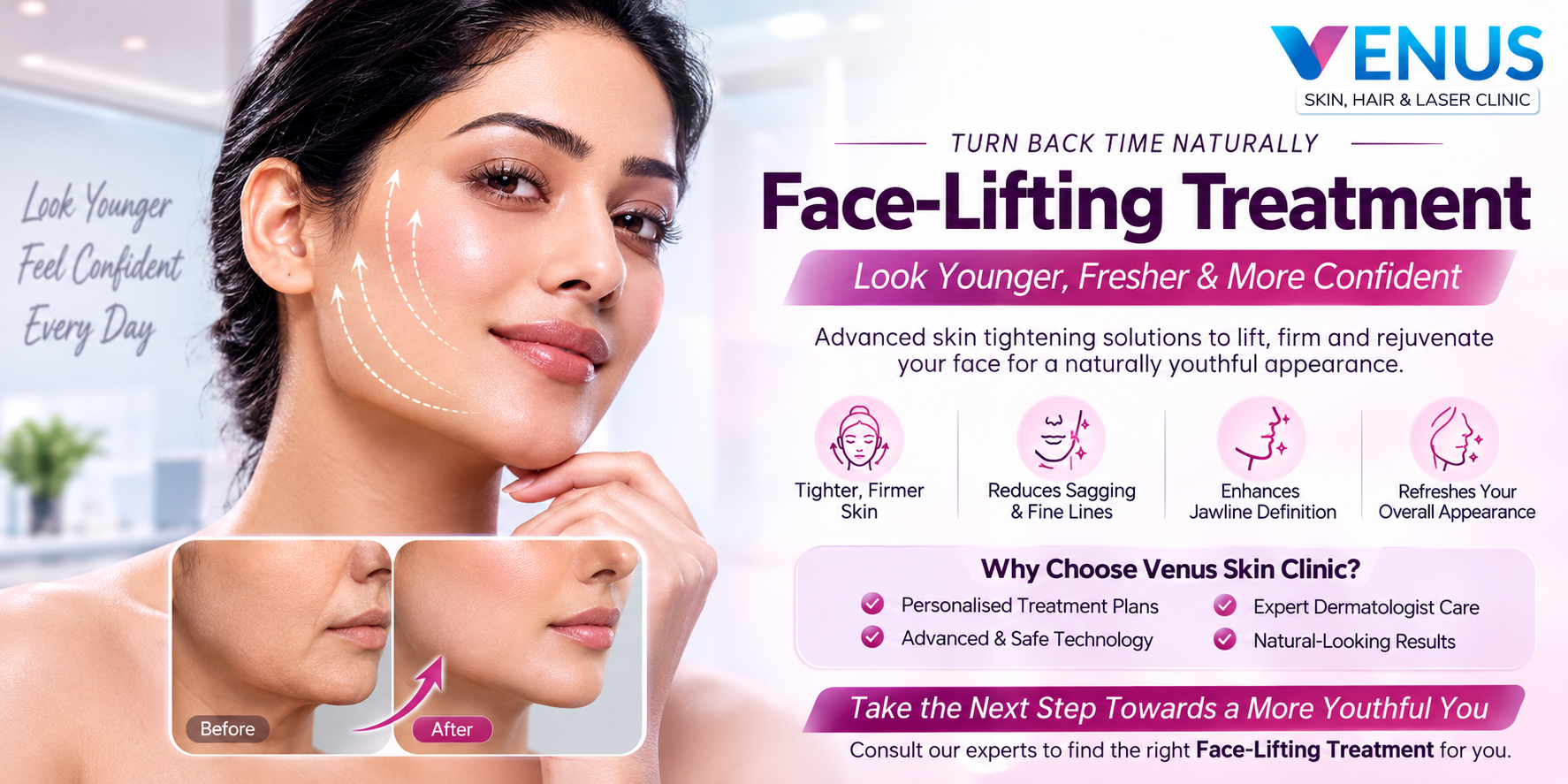
Face-lift treatment in Chennai includes non-surgical skin-tightening procedures, minimally invasive treatments, and surgical face-lift procedures. The right option depends on skin laxity, facial volume, age-related changes, and desired results. Non-surgical treatments generally involve less downtime but provide more subtle lifting, while surgery can offer more significant correction. A consultation with a qualified dermatologist or plastic surgeon is recommended to determine the appropriate treatment and expected face-lifting treatment price.
Add this section near the beginning, after the introduction:
This guide is useful if you are:
By the end of this guide, you’ll understand:
When the skin around the cheeks, jawline, or neck starts to sag, many people assume that surgery is the only way to achieve a firmer, more youthful appearance. That isn’t always the case.
Today, face lift treatment in Chennai can refer to several approaches, from non-invasive skin-tightening procedures to minimally invasive treatments and surgical facelift procedures. The right choice depends on how much skin laxity you have, your facial structure, your expectations, and how much downtime you’re comfortable with.
This guide explains the different types of face lifting treatment, what each option can realistically achieve, how the treatment is performed, what affects the face lifting treatment price, and what to consider before choosing a clinic in Chennai.
Face-lifting treatment is a broad term used for procedures designed to improve facial sagging, skin laxity, loss of definition, and certain signs of aging.
Depending on the treatment, the goal may be to
A key point is that not every face-lifting procedure is a facelift.
A surgical facelift physically repositions tissues and removes excess skin. Non-surgical treatments work differently. For example, ultrasound and radiofrequency-based procedures use controlled energy to heat deeper tissue and stimulate collagen production. The American Academy of Dermatology notes that non-invasive tightening generally produces more modest results than surgery but usually involves considerably less downtime.
A face-lifting treatment may be considered by adults who notice the following:
However, the most suitable procedure cannot be selected from age alone. Two people of the same age can have very different skin quality, facial volume, and degrees of sagging.
There is no single treatment that works equally well for every type of facial aging. A consultation should determine whether the main issue is loose skin, volume loss, muscle activity, or a combination of these.
Non-surgical treatments are often considered when the patient has mild or moderate laxity and wants little or no downtime.
Depending on the device and treatment plan, options may include:
These treatments work by delivering controlled energy into targeted tissue. The resulting tissue response can stimulate collagen production over time.
Results are usually gradual rather than immediate. The American Academy of Dermatology explains that ultrasound and radiofrequency treatments can produce progressive tightening, with results developing over the following months.
Best suited for early to moderate laxity, patients seeking gradual improvement, and people who want to minimize downtime.
Some procedures use needles, small instruments or energy delivered beneath the skin. They can provide more targeted tightening than completely non-invasive treatments but may involve more recovery.
The treatment selected depends on the area being treated and the amount of laxity.
Best suited for: Selected patients who need more noticeable tightening but aren’t ready for or don’t require conventional facelift surgery.
Aging isn’t always caused by loose skin alone. Loss of facial volume can make the cheeks look flatter and the lower face appear less defined.
In appropriate patients, dermal fillers can restore volume to areas such as the cheeks or chin and improve facial proportions. They don’t physically remove loose skin, so they shouldn’t be considered a replacement for a surgical facelift.
Fillers are medical procedures and have potential risks, including swelling, bruising, and, rarely, serious complications from accidental injection into a blood vessel. The FDA recommends that fillers be administered by appropriately trained licensed healthcare professionals.
Best suited for: Selected patients whose facial aging is partly related to volume loss or contour changes.
A surgical facelift is a different category of treatment. It is designed for more significant facial aging and skin laxity.
Depending on the technique, a surgeon may reposition deeper facial tissues and remove excess skin. Facelift techniques can vary considerably, including approaches involving the SMAS layer beneath the skin.
A surgical facelift generally offers a more substantial change than non-surgical skin tightening, but it also involves surgery, anesthesia, recovery, and potential complications.
Best suited for: Patients with significant skin laxity who want a more substantial and longer-lasting structural change.
The exact process depends on the treatment selected.
A qualified dermatologist or plastic surgeon should first assess the following:
This assessment matters because tightening already-thin skin isn’t the same problem as correcting substantial tissue descent or restoring lost volume.
Your doctor may recommend one procedure or, in selected cases, a combination approach.
For example, someone with mild skin laxity and good facial volume may benefit from an energy-based tightening treatment. Someone with significant sagging and excess skin may need a surgical assessment instead.
Non-invasive treatments typically involve applying a device to selected areas of the face. Depending on the technology, patients may experience warmth, pressure, or temporary discomfort.
Injectable treatments involve carefully planned injections into specific facial areas.
Surgical facelift procedures involve incisions and repositioning of facial tissues under the supervision of a qualified surgeon.
Aftercare varies significantly between procedures.
Non-surgical treatments may require minimal downtime, while injectable treatments can cause temporary swelling or bruising. Surgical procedures require substantially more recovery and structured postoperative care.
Your clinician should explain exactly what to expect before treatment rather than promising a generic recovery timeline.
One of the most important questions to ask is not simply, “Will it lift my face?” But “How much improvement is realistic for my degree of aging?”
Non-surgical treatments generally produce more subtle results than surgery. The improvement may develop gradually as collagen remodeling occurs.
You may notice:
However, a non-surgical treatment cannot reproduce the structural changes of a surgical facelift.
The American Academy of Dermatology specifically distinguishes non-invasive tightening from surgical lifting, noting that a facelift generally provides the most dramatic lifting result.
There isn’t one universal answer.
The duration depends on:
A reputable clinic should avoid guaranteeing a fixed duration for every patient.
The face-lifting treatment price in Chennai can vary substantially because “face lifting” covers several different procedures.
A consultation may be priced differently from a complete treatment plan, and the cost of a non-surgical procedure should not be compared directly with the price of surgery.
Common factors affecting the price include:
| Factor | Why It Affects Cost |
|---|---|
| Type of Treatment | Different technologies and procedures have different costs |
| Treatment Area | Full-face treatment may cost more than a smaller area |
| Degree of Laxity | More extensive correction may require a different treatment plan |
| Number of Sessions | Some non-surgical treatments may require multiple sessions |
| Device or Technology | Equipment and treatment protocols vary |
| Doctor’s Expertise | Specialist consultation and treatment experience can affect fees |
| Combination Treatments | Treating skin laxity and volume loss together may increase the total |
| Follow-up Care | Surgical procedures require more extensive postoperative monitoring |
Not necessarily.
Price should be considered alongside the qualifications of the treating doctor, the technology being used, patient assessment, safety protocols, follow-up care, and whether the proposed treatment actually matches your concern.
Before comparing quotes, ask:
This gives you a much more meaningful comparison than looking at a single advertised price.
Choosing the procedure is only half the decision. Choosing the right medical professional is equally important.
Depending on the procedure, treatment may be performed by a dermatologist, a plastic surgeon, or another appropriately qualified medical professional.
Ask about the doctor’s relevant training and experience with the specific procedure being recommended.
A good consultation should explain why a particular procedure is appropriate.
Be cautious if every patient is offered exactly the same treatment regardless of their facial anatomy or degree of aging.
A responsible clinician should explain both the benefits and limitations.
For example, if you have substantial excess skin, a non-surgical tightening procedure may improve firmness but may not remove the excess skin.
Every medical procedure carries some risk. The level and type of risk depend on the treatment.
For injectable procedures, for example, common effects can include swelling, redness, and bruising. Rare vascular complications can be serious.
For surgery, complications can include bleeding, infection, wound-healing problems, scarring, and other surgical risks. Facelift surgery should therefore be approached as a medical procedure rather than simply a beauty treatment.
A good treatment plan doesn’t end when you leave the clinic.
Ask who you can contact if you experience unexpected swelling, pain, skin changes, or another concern after treatment.
The answer depends on what you want to change.
| Your Main Concern | Treatment Category That May Be Considered |
|---|---|
| Mild Skin Laxity | Non-Surgical Skin Tightening |
| Early Jawline Laxity | Energy-Based Tightening or Other Suitable Non-Surgical Options |
| Facial Volume Loss | Dermal Fillers or Other Volume-Restoring Approaches |
| Moderate to Significant Sagging | Individual Assessment for Minimally Invasive or Surgical Options |
| Significant Excess Skin | Surgical Facelift Assessment |
| Fine Lines and Poor Skin Texture | Skin-Quality Treatments May Be Considered Alongside Lifting |
This table is only a general guide. Facial anatomy varies from person to person, so treatment should be selected after an in-person medical assessment.
If you’re considering face-lift treatment in Chennai, don’t choose a procedure solely because it is popular or heavily advertised. The most appropriate option is the one that addresses the underlying cause of your facial aging while matching your expectations, health, and tolerance for downtime.
There is no single best treatment for everyone. Non-surgical tightening may suit mild laxity, while significant sagging or excess skin may require a surgical facelift assessment. A dermatologist or plastic surgeon can recommend the appropriate option after examining your face.
The face-lifting treatment price varies according to the procedure, treatment area, number of sessions, technology used, and the doctor’s assessment. It is better to obtain a treatment-specific quote rather than compare generic “facelift” prices.
The level of discomfort depends on the procedure. Non-invasive treatments may cause warmth, pressure, or temporary discomfort, while injectable and surgical procedures involve different forms of anesthesia or pain management. Your doctor should explain this before treatment.
The duration varies according to the treatment, individual aging process, and maintenance plan. Some non-surgical procedures produce gradual improvements rather than a permanent lift, so follow-up or maintenance treatment may sometimes be recommended.
No. Non-surgical treatments can improve mild to moderate laxity with less downtime, but they generally cannot produce the same degree of lifting and tissue repositioning as a surgical facelift.
Facial aging isn’t caused by one thing. Skin laxity, collagen loss, changes in facial fat, and structural changes can all contribute to an older-looking appearance. That’s why the best facelift treatment in Chennai isn’t necessarily the most expensive, newest, or most aggressively marketed procedure.
The right treatment starts with an accurate assessment of your facial concerns and a realistic discussion about what can be achieved.
If you’re considering face-lifting treatment in Chennai, schedule a consultation with a qualified dermatologist or plastic surgeon. Ask about the recommended procedure, expected results, face-lifting treatment price, recovery, risks, and alternatives before making your decision.
A well-planned treatment should aim to make your face look refreshed and natural—not simply “tighter.”
