Medically Reviewed By: Dr. Sharanya Karthik, MBBS, MD, DVL, Consultant Cosmetic Dermatologist, Venus Skin Clinic, Chennai
Experience: 11+ years in dermatology and aesthetic skin treatments
Last Medical Review: August 2026
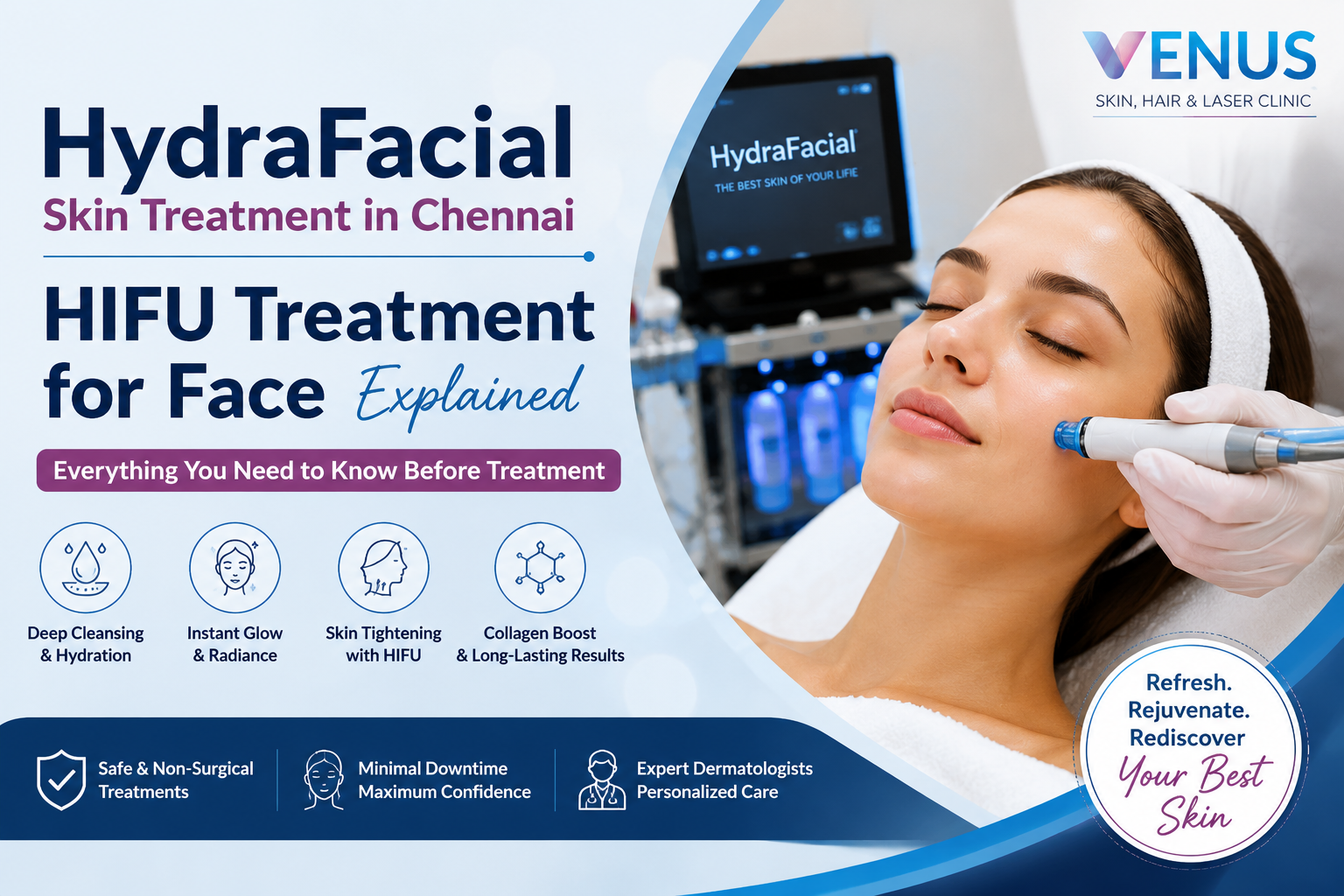
If your skin looks dull, dehydrated, or tired, a HydraFacial may seem like the obvious choice. But if your main concern is loose skin, reduced firmness, or early facial sagging, a different treatment may be more appropriate.
This is where many people get confused between HydraFacial skin treatment in Chennai and HIFU treatment for the face. They aren’t interchangeable procedures. HydraFacial is primarily a skin-refreshing treatment, while HIFU uses focused ultrasound energy to target deeper tissue and support skin tightening.
This guide explains the differences, what each treatment is designed to address, who may benefit, what the procedure involves, possible limitations, and how to choose the right option with a qualified aesthetic or dermatology professional in Chennai.
HydraFacial is a non-invasive facial treatment that combines several skin-care steps in one session. Depending on the system and clinic protocol, these may include cleansing, exfoliation, extraction, and the application of hydrating or antioxidant-focused solutions.
The treatment is generally chosen by people who want their skin to look cleaner, smoother, fresher, and more hydrated without significant downtime.
HydraFacial may be considered for concerns such as:
Results can vary considerably depending on your skin condition, treatment protocol, and skincare routine.
A useful distinction: HydraFacial primarily works on the skin’s surface and superficial concerns. It isn’t designed to provide the same type of tissue-tightening effect as HIFU.
Internal linking opportunity: Link this section to your dedicated HydraFacial Treatment in Chennai service page for readers who want to understand the procedure in greater detail.
HIFU treatment for the face uses focused ultrasound energy to deliver controlled energy into targeted tissue beneath the skin. The objective is to create a controlled thermal effect at specific depths, which can stimulate a wound-healing response and collagen remodeling.
HIFU is therefore generally considered when the primary concern is skin laxity and loss of firmness, rather than simply dull or dehydrated skin.
It is often discussed for areas such as the following:
The exact treatment depth, energy settings and treatment areas should be selected by a qualified practitioner after assessing the individual’s anatomy and skin concerns.
No.
HIFU is a non-surgical aesthetic treatment and shouldn’t be presented as an equivalent to surgical facelift procedures. A facelift physically repositions and removes tissue, whereas HIFU uses energy delivered beneath the skin.
For someone with substantial skin laxity, a clinician may recommend discussing surgical or other treatment options rather than assuming HIFU will provide the desired degree of lifting.
The best treatment depends on the problem you’re actually trying to solve.
| Concern | HydraFacial | HIFU |
|---|---|---|
| Dull-Looking Skin | ✓ | Not the primary purpose |
| Dehydration | ✓ | Not the primary purpose |
| Surface Congestion | ✓ | No |
| Skin Texture | ✓ | Limited / Not the primary focus |
| Skin Firmness | Limited | ✓ |
| Mild Facial Laxity | Not the primary treatment | ✓ |
| Jawline Definition | No | May be considered |
| Under-Chin Laxity | No | May be considered |
| Immediate Skin Refresh | Common treatment goal | Not the main goal |
| Collagen Remodeling | Not its main mechanism | ✓ |
In simple terms, HydraFacial is generally about improving the appearance and feel of the skin, while HIFU is more focused on deeper tissue tightening and collagen remodeling.
That doesn’t mean one treatment is universally better than the other. They address different concerns.
This is common. For example, someone in their 30s or 40s may have both:
In such a situation, a dermatologist or qualified aesthetic practitioner may assess whether separate treatments are appropriate rather than trying to make one procedure solve every concern.
The timing and combination of procedures should be determined professionally. More treatment isn’t automatically better treatment.
A typical HIFU treatment in Chennai begins with a consultation rather than immediately starting the procedure.
The practitioner evaluates your skin, degree of laxity, facial structure, and treatment goals.
This step matters because ultrasound treatment isn’t simply a matter of applying the same settings to every face.
The practitioner identifies the areas that may benefit from treatment and selects an appropriate device, cartridge, or treatment depth according to the equipment being used.
Ask the clinic which HIFU platform is being used and whether the practitioner is trained to operate it.
The skin is cleansed and prepared before treatment. Depending on the protocol, a suitable ultrasound coupling medium or gel may be applied.
The device delivers focused ultrasound energy to predetermined areas.
You may experience sensations such as warmth, tingling, or brief discomfort during some pulses. Individual experiences vary.
Because HIFU is non-surgical, many people can return to their normal activities relatively quickly. However, temporary redness, tenderness, swelling, or sensitivity can occur.
Your practitioner should explain what is normal after treatment and when you should contact the clinic.
One of the biggest misconceptions about HIFU is expecting an immediate facelift-like transformation.
HIFU results are generally associated with gradual tissue response and collagen remodeling rather than an instant surgical lift.
You may notice some initial changes, but the more meaningful improvement can develop progressively over the following weeks or months.
Results vary based on factors such as:
The longevity of results also varies. A consultation is therefore more useful than relying on a fixed promise such as “one treatment lasts exactly X months.”
No.
HIFU tends to be more suitable for selected individuals with mild to moderate skin laxity. Someone with significant sagging may not achieve the degree of lifting they expect from a non-surgical procedure.
This is why an honest assessment is more valuable than a clinic promising the same result to every patient.
Pain tolerance differs from person to person.
During treatment, some people describe sensations such as the following:
Some areas of the face may feel more sensitive than others.
A qualified practitioner should explain what sensations to expect and discuss appropriate comfort measures before treatment.
If you’re particularly sensitive to discomfort, tell the practitioner during your consultation rather than trying to tolerate unexpected pain during the procedure.
HIFU may be considered by adults who are concerned about early or moderate facial skin laxity and want a non-surgical approach.
You may be a potential candidate if you notice the following:
However, suitability can’t be determined from age alone.
A consultation is particularly important if you have previous cosmetic procedures, unusual facial anatomy, significant skin conditions, or other medical factors that could affect treatment.
Pregnancy, certain implanted devices, or medical conditions may also affect whether an energy-based aesthetic procedure is appropriate. A qualified clinician should review your medical history before treatment.
The HIFU treatment cost in Chennai can vary significantly between clinics and patients.
There isn’t one universal price because the total cost may depend on:
Be cautious about comparing prices based only on the headline number.
A cheaper treatment isn’t necessarily comparable to a higher-priced treatment if the devices, treatment area, number of shots, or practitioner qualifications are different.
Before booking, ask the clinic:
Internal linking opportunity: Add a contextual link here to your HIFU Treatment Cost in Chennai guide.
Start with your main concern rather than the treatment name.
If your biggest concern is dull, dehydrated, or congested skin, HydraFacial may be more relevant.
If your concern is loss of firmness, mild sagging, or reduced jawline definition, HIFU may be worth discussing with a qualified practitioner.
If you’re experiencing both concerns, a professional assessment can help determine whether one treatment, separate treatments, or a different approach would make more sense.
The right question isn’t “Which treatment is better?”
It’s
That shift can prevent unrealistic expectations and unnecessary procedures.
When researching a clinic, don’t judge it only by Instagram photographs or promotional pricing.
Look for evidence of responsible clinical practice.
Find out who will assess you and perform the procedure. A qualified medical professional should be able to explain why the treatment is suitable and what its limitations are.
Different ultrasound-based systems can have different characteristics. Ask for the exact device name rather than accepting a generic statement that the clinic offers “advanced HIFU.”
A good consultation should cover your concerns, medical history, previous procedures, expected results and possible risks.
Claims such as “permanent lifting,” “100% wrinkle removal,” or identical results for every patient should raise questions.
A trustworthy clinic should explain both what HIFU can potentially improve and what it cannot realistically achieve.
Internal linking opportunity: Link to your Dermatologist in Chennai or Skin Consultation in Chennai page to help readers understand the value of professional assessment before treatment.
Neither treatment is universally better. HydraFacial is mainly used for surface-level skin concerns such as dullness, congestion, and dehydration, while HIFU is primarily considered for skin laxity and tightening.
Treatment time depends on the area being treated, the device, and the treatment plan. A smaller area may take less time than a full-face and neck procedure. Your clinic should provide a more accurate estimate after assessment.
HIFU can be used as a non-surgical aesthetic treatment when an appropriate device is used correctly and the patient is properly assessed. Temporary effects such as redness, tenderness, swelling, or sensitivity can occur. Discuss your medical history and any concerns with your practitioner beforehand.
Some people notice an early change, but HIFU-related improvement is generally gradual. Collagen remodeling takes time, so the final visible result shouldn’t be judged immediately after treatment.
They address different concerns, so they may sometimes form part of a broader skin-treatment plan. However, they shouldn’t automatically be combined in the same session. A qualified practitioner should decide whether the treatments and timing are appropriate for your skin.
Yes, HydraFacial can be useful for improving the appearance of dull, dehydrated, or congested skin. It combines cleansing, exfoliation, extraction, and hydration-focused steps. The treatment is generally intended to improve skin freshness and texture rather than provide significant skin tightening or lifting.
The ideal frequency depends on your skin type, concerns, and treatment goals. Some people may benefit from periodic sessions, while others may only need a HydraFacial before a special occasion or when their skin feels congested or dull. A dermatologist can recommend an appropriate schedule based on your skin.
HydraFacial may help improve the appearance of uneven-looking skin and superficial dullness, but it isn’t a universal treatment for pigmentation. Persistent or deeper pigmentation may require a different treatment plan after a proper skin assessment.
Some people with sensitive skin can undergo a HydraFacial, but the treatment should be adjusted according to their skin condition. If you have active irritation, inflammation, infection, or a compromised skin barrier, your dermatologist may recommend postponing treatment until the skin has recovered.
A typical HydraFacial session may take around 30 to 60 minutes, depending on the treatment protocol and whether additional steps are included. Your clinic can provide a more accurate estimate during consultation.
HydraFacial and HIFU target different concerns. HydraFacial focuses primarily on cleansing, exfoliation, and hydration, whereas HIFU is used for selected cases of skin laxity and tightening. They may sometimes be included in an overall treatment plan, but the timing and suitability should be decided by a qualified dermatologist.
HydraFacial skin treatment in Chennai and HIFU treatment for the face serve different purposes. HydraFacial is generally chosen to refresh, cleanse, and hydrate the skin, while HIFU is considered for selected cases of skin laxity and gradual tightening.
If you’re mainly concerned about dullness or dehydration, start by exploring HydraFacial. If your concern is sagging, reduced firmness, or jawline definition, discuss HIFU with a qualified dermatologist or aesthetic practitioner.
The most useful next step is a professional consultation where your skin, facial structure, and expectations can be assessed before deciding on treatment. That approach helps you choose a procedure for the problem you actually want to solve—not simply the treatment that happens to be trending.
